
Priorities of Uzbekistan in the OTG - a factor in ensuring sustainable development of Turkic countries
The evolution of the Organization of Turkic States (OTS) attracts special attention from the international expert community, especially in the context of sustainable development. One of the important events along this path was the accession of Uzbekistan to the organization in 2019, which served as a catalyst for the formation of new opportunities for joint progress of the Turkic countries.
Originally established on October 3, 2009 as the Cooperation Council of Turkic-Speaking States, the organization has undergone significant institutional evolution over time. At the VIII Summit in Istanbul on November 12, 2021, it was officially renamed the Organization of Turkic States. This decision reflected the deepening of interaction between the member states and the joint desire to develop a collective approach to modern risks and challenges in the field of sustainable development of the Turkic space. In this context, Uzbekistan soon began to play a significant role.
Tashkent’s policy within the framework of the UTC was reflected primarily in the economic sphere, where deepening integration became not only an indicator of growing trust, but also a practical basis for jointly ensuring stability and long-term progress.
These positive trends are confirmed by specific economic indicators. By 2024, the volume of mutual trade between the UTC member countries exceeded $45 billion, and the total GDP of the five member states reached $1.9 trillion, which evidenced growing economic interdependence. According to the Center for Economic Research and Reforms (CERR), Uzbekistan’s trade turnover with UTG countries increased from $3.34 billion in 2016 to $9.4 billion in 2023, and by 2024 reached $10 billion, which is almost three times higher than seven years ago.
The dynamic growth of economic ties not only strengthened the mutual interest of the UTC countries in the stability of the region, but also created a solid basis for the formation of a new approach to security issues, which Uzbekistan is actively promoting in foreign policy.
Analysis of the initiatives put forward by the President of Uzbekistan Shavkat Mirziyoyev at the UTC summits confirms a consistent and systematic approach Tashkent to strengthen regional security. In place of the traditional military-political dimension, Uzbekistan is promoting a model in which security is understood as the result of sustainable development, interconnectedness and long-term structured cooperation.
This approach is embodied in the following strategic directions, covering key aspects of modern security.
FirstlyUzbekistan was one of the first in the region to propose cooperation in the field of response to systemic threats. In the context of the COVID-19 pandemic (April 2020), an initiative was put forward to create a permanent epidemiological surveillance mechanism, a coordination group under the ATC Secretariat and building a partnership with WHO.
After the earthquake in Turkey (March 2023), Tashkent initiated the formation of a platform for practical cooperation of ATCs to prevent and overcome the consequences of emergencies, as well as the development multilateral agreement on risk reduction and the establishment of a Disaster Monitoring Center in Tashkent.
All these measures were aimed at early warning of emergencies, vulnerability reduction and collective resilience, which are key elements of preventive security.
Secondly,Uzbekistan is promoting issues of sustainable development through deepening economic interconnectedness.
Thus, in the transport sector, the joint use of the multimodal corridor “Tashkent-Karakalpakstan-Aktau-Baku-Tbilisi-Kars-Istanbul”, the introduction of a “single window” system and “green corridors” on the Trans-Caspian route, as well as complete digitalization of vehicles through the eTIR system. In 2022, Uzbekistan and Azerbaijan became the first countries to successfully carry out a transport operation using eTIR electronic books.
In the food sector, Uzbekistan has put forward the development of a multilateral supply chain agreement and cooperation with FAO.
In the environmental sector, the creation of a Turkic structure for environmental protection has been proposed with headquarters in the Aral Sea region, the establishment of the Ecology Council and the adoption of the concept of the “Turkish movement to green energy”.
All these initiatives form an infrastructural and economic basis for security, reducing dependence on external shocks and strengthening regional autonomy.
Thirdly,Tashkent’s key contribution is to promote institutionalization OTG. Thus, at the Samarkand summit (November 2022), the idea of creating separate committees at the ministerial level for energy, IT, medicine and other areas was voiced.
Later, Uzbekistan initiated the location of the headquarters of strategically important structures in Tashkent: the Center for Emergency Situations, the Council of Railway Administrations, the Turkic Development Bank, Research Center for Human Capital Development and the Academy of Space Research.
During the chairmanship of Uzbekistan in the UTC (2022–2023), more than 100 events were held, new interaction platforms were created, including the Organization of Trade Unions of Turkic States and the Institute for Drought Prevention.
These measures allow us to increase the level of joint readiness and rapid response to modern challenges, strengthening trust between member states and promoting sustainable development.
Fourth, along with strengthening cooperation in the humanitarian, economic and legal spheres, Uzbekistan is consistently developing areas of interaction related to coordination in preventing threats to stability in the region.
For example, in July 2024, at the summit in Shusha, it was proposed to develop common approaches of the members of the UTC to the Afghan issue in the new reality. These kinds of initiatives reflect Uzbekistan’s desire to consolidate foreign policy positions and formulate a coherent strategy regarding the most sensitive issues of regional stability.
Thus, Uzbekistan’s initiatives in the UTC form a holistic, preventive-oriented model of sustainable development, in which humanitarian, economic, environmental and political components are considered as interdependent. Tashkent’s approach not only corresponds to modern trends in international relations, but also creates conditions for strengthening the strategic autonomy of the Turkic space in conditions of global fragmentation.
However, it is worth noting that this model is not isolated in its development. On the contrary, it is organically complemented by the external openness of the UTC and its desire to integrate into the international architecture of relations through cooperation with key global and regional institutions, which avoids duplication, increases the legitimacy of its own initiatives and brings them into line with international standards.
Uzbekistan makes a significant contribution to this process, consistently promoting the idea of synergy between the ATC and multilateral platforms, especially in the epidemiological, environmental and humanitarian fields.
The ATC develops the closest cooperation with the United Nations and its specialized agencies. Uzbekistan's initiative to create a Turkic structure for environmental protection under the auspices of the UN with headquarters in the Aral Sea region (2021) is directly focused on integrating regional efforts into the global environmental agenda.
Proposals for interaction with the Food and Agriculture Organization of the United Nations (FAO) (2022) and cooperation with the World Health Organization (WHO) (2020) also indicate a desire to use the expert and institutional potential of the UN to implement its own security mechanisms.
Along with this, Tashkent initiated the establishment of partnerships with the UN Office for Disaster Risk Reduction (UNDRR) and the Global Facility for Disaster Risk Reduction and Recovery (GFDRR) in the context of the creation of the Disaster Monitoring Center (2023), which emphasizes the OTC's commitment to the principles of sustainable development and preventive security, enshrined in the UN Agenda 2030.
At the same time, the UTC is expanding its international presence: in 2024, the organization received observer status in the Economic Cooperation Organization (ECO), submitted a similar application to the UN and OIC, and its European office in Budapest is strengthening ties with the EU and OSCE. At the Budapest Informal Summit (May 2025), which was organized for the first time by an observer country, the Budapest Declaration was adopted, cementing the OTC's commitment to the fight against terrorism, cyber threats and organized crime.
This foreign policy vector is also confirmed in the assessments of international analytical circles.
Thus, according to an analytical report by the Center for Global Security Studies at the Geneva Institute of International Affairs (Geneva Center for Security Policy, GCSP), the UTG demonstrates a unique model of regional cooperation, combining cultural identity with pragmatic measures to reduce vulnerability to cross-border threats. Experts from the Center for Analysis of International Relations "AIR Center" (Azerbaijan) note that for the countries of Central Asia and Azerbaijan, the UTG has become a strategic shield against external threats and a platform for asserting independence.
Thus, the UTG not only strengthens the collective resilience of member states to external challenges, but also creates space for developing joint approaches to the implementation of projects aimed at the sustainable development of Turkic countries.
In this regard, Uzbekistan is consistently promoting a comprehensive, preventive-oriented model of responding to risks and factors that undermine sustainable development, in which traditional threats are complemented by non-traditional challenges: from pandemics and natural disasters to destructive ideologies. Particular attention is paid to building trust through humanitarian diplomacy, youth initiatives, cultural rapprochement and institutional cooperation.
In the context of regional stability, Uzbekistan advocates for the development of common approaches to the Afghan issue, supports efforts to counter terrorism and organized crime, and also initiates the creation of mechanisms for collective response to crises.
The adoption of the Turkic Peace Charter at the 11th UTC summit in Bishkek and the proposal put forward at the same forum by the President of Uzbekistan Shavkat Mirziyoyev to sign the Treaty on Strategic Partnership, Eternal Friendship and Brotherhood of the Turkic States became important factors in the formation of a long-term architecture of trust and shared responsibility.
In In general, Uzbekistan's initiatives within the framework of the UTG represent a comprehensive strategy aimed at creating an alternative model for ensuring sustainable regional development, which is based on the cultural-historical commonality and economic interconnectedness of the Turkic countries.
Alisher Kadirov,
Head Department
Institute of Strategic and Interregional Studies
under the President of the Republic of Uzbekistan
Related news
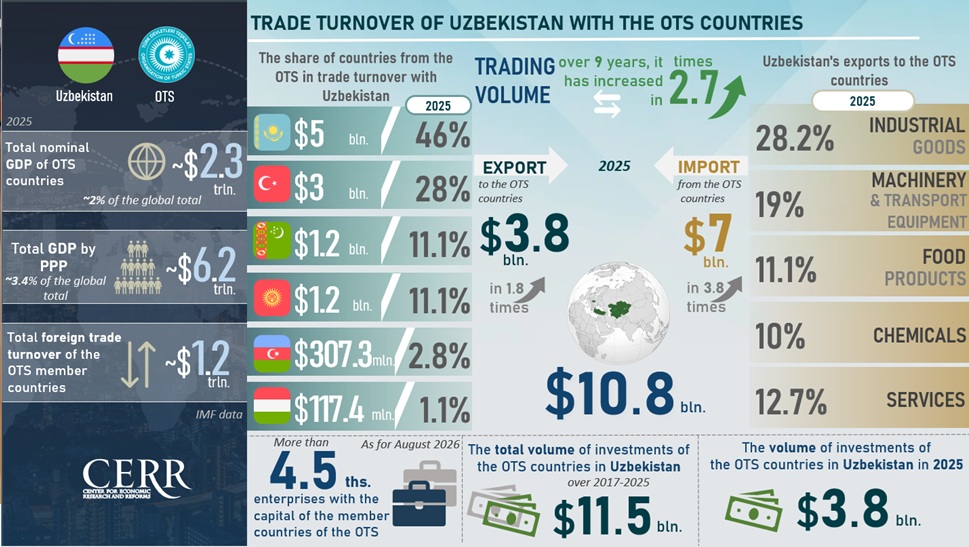
Uzbekistan has moved its economic cooperation with the Turkic states into a practical dimension
Ahead of the 13th Summit of the Organization of Turkic States, scheduled to be held in Ankara, economic cooperation within the OTS is acquiring new substance.
Water security in the turkic world: shared interests and common solutions
Water is a precious blessing that transcends national borders and has long connected peoples and civilizations.

Strengthening Transport Connectivity in Asia through the Development of the Trans-Caspian International Transport Corridor
Shifting international supply chains and expanding trade in Asia are driving demand for sustainable transport routes. For businesses, predictable delivery times, competitive rates, and reliable access to foreign markets are becoming increasingly important.