
Tasks have been identified to ensure high rates of economic growth in industries and regions
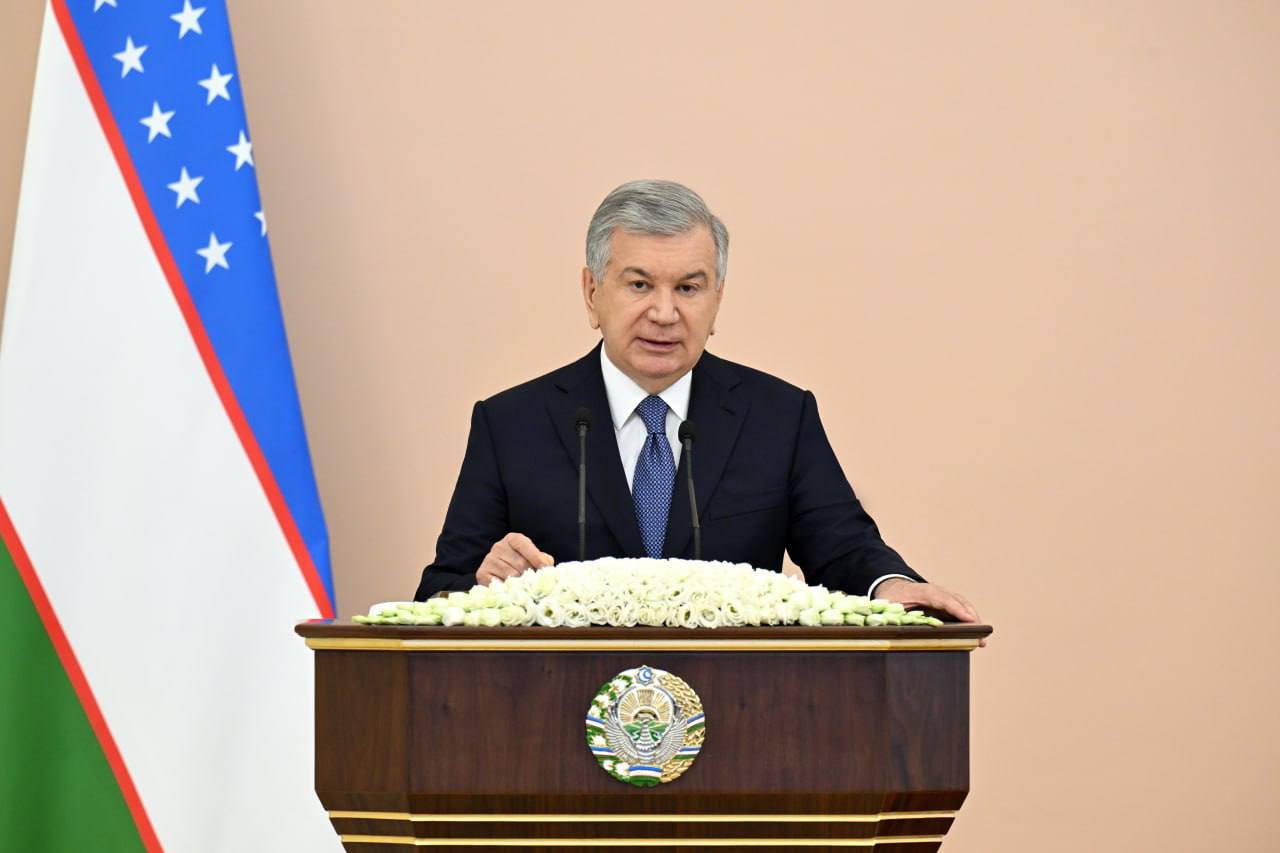
Under the chairmanship of President Shavkat Mirziyoyev, a video conference meeting was held on February 13 to discuss the main tasks of ensuring high rates of economic growth in industries and regions.
At the beginning of the meeting, macroeconomic indicators for the past year were reviewed. Our country's gross domestic product grew 7.7 percent to more than $147 billion. More than half of economic growth came from services. In agriculture, the average income per hectare increased from 4.5 thousand to 5 thousand dollars, labor productivity increased by 4.7 percent.
As a result of the introduction of advanced, energy-saving technologies into the economy and an increase in the number of projects with high added value, the energy costs required to create one dollar of added value decreased by 15 percent in one year.
Touching on the indicators, set for 2026, the President of our country emphasized that the plan to bring the gross domestic product to $167 billion with an expected economic growth rate of 6.6 percent is based on a conservative forecast, formed taking into account the current geopolitical situation and foreign economic volatility.
It was also noted that there is every opportunity to ensure even higher rates of economic growth if every minister, khokim and industry leader implements in its field, new management methods will ensure the efficient use of resources, not limited to traditional markets, will open new export directions, attract specialists in the field of digitalization and artificial intelligence to introduce innovations, and also create “start-up clubs” with the active participation of youth.
At the meeting, issues of increasing the efficiency of strategic enterprises and reducing costs were comprehensively discussed.
It was noted that, according to the analysis of the Franklin Templeton company, which was involved in the management of the National Investment Fund, there is significant unrealized potential in the field of strengthening corporate culture, optimizing logistics, digitalization and increasing energy efficiency. The heads of 19 strategic enterprises have been instructed to take decisive measures in the areas of procurement, logistics, digitalization and energy efficiency and ensure a reduction in costs by 10-15 percent.
– Savings should be achieved not by reducing production, but by reducing unit costs, the President said.
In addition, it was emphasized the importance of including strategic enterprises in the Single Treasury information system and stopping ineffective spending by classifying purchases based on risk analysis.
Shortcomings in the development of regional industry were sharply criticized. Although the republic's industry grew by 21 percent over three years, in a number of districts the growth did not reach 10 percent, and in some regions the increase in credit resources and investments does not have a proportional impact on the development of the industrial sector.
The deputy khokims of the regions were tasked with working directly on site for a month in 12 districts, reviving enterprises with reduced production and ensuring industrial growth in these areas.
It was decided to approve regional and regional plans to ensure the growth of the republic’s industry at a level of at least 8.5 percent, and also to evaluate the activities of managers taking into account the identified problems and their solutions based on the results of the first quarter.
It is noted that in our country there are 4 large enterprises with an annual production capacity of 650 thousand cars. This year it is necessary to begin production of another 763 parts based on cooperation with more than 300 local enterprises and increase the production of cars to 510 thousand. In order to stimulate demand among the population, it was instructed to take measures to reduce rates and increase the volume of car loans.
New management approaches have been identified to attract investments and effectively implement projects.
It was emphasized that this year it is planned to attract foreign investment in the amount of $50 billion and new projects should primarily contribute to the production of export-oriented products with high added value and ensure the efficient use of resources and create highly profitable jobs.
Ministers and khokims are instructed to conduct a comprehensive analysis assessing the market, export potential, added value and jobs created for each project included in the investment program for 2026.
Now, when working with investment projects, strict control will be established not only over the launch of the project, but also over its full operation, creation of high added value and access to foreign markets. To this end, a “Unified National Project Management” platform will be created that will track each project included in the program for three years after launch.
Noting that 55 major projects were postponed last year due to various organizational problems, it was decided to transfer 377 strategic projects worth $165 billion to special control this year.
It was noted that during foreign visits agreements were reached for $135 billion. This year alone, investment agreements worth $9 billion were signed with Turkey and $1.428 billion with Pakistan.
The task has been set to increase construction volumes by expanding investments. Responsible persons have been instructed to increase the volume of construction this year to 400 trillion soums, ensuring growth in the industry by at least 17 percent. It was noted that 40 trillion soums allocated from the budget for social and industrial infrastructure contribute to the formation of a large sales market for construction, metallurgical and electrical enterprises, as well as organizations producing building materials.
At the same time, the need was emphasized for strengthening control over engineering companies “Single Customer Service” in the regions, as well as involving the private sector in customer services in Karakalpakstan, Samarkand and Fergana as an experiment.
Specific instructions on improving energy efficiency were also given.
Taking into account the high level of annual energy consumption in small and medium-sized enterprises, it was decided to introduce a new energy efficiency system and develop a three-year program for this category of enterprises. The importance of taking measures to save 100 million cubic meters of gas and 500 million kilowatt-hours of electricity in small and medium-sized enterprises in 2026 was noted.
In addition, it was indicated that 917 thousand street lights in the republic consume 330 million kilowatt-hours of electricity per year, while some of them remain on even during the day. It was ordered to begin installing small solar panels, batteries and sensors on the lamp supports that independently turn the lights on and off depending on the illumination.
At the meeting, special attention was also paid to the issues of increasing the share of domestic producers in government procurement.
As noted, although in government procurement worth 300 trillion soums the share of local products reached 68 percent, in the systems of the Almalyk Mining and Metallurgical Combine, joint-stock companies "Uztransgaz", "National Electric Grids", "Uzbekistan Airports" and "Uzbekistan Airways" this figure does not even reach 40 percent. Entrepreneurs also note a large number of bureaucratic procedures in the processes of public procurement, examination and certification, and some managers still adhere to the outdated opinion that “foreign is better in quality.”
Now ministers, industry leaders and khokims will be personally responsible for increasing the share of local products at all stages of projects - from negotiations and tenders to construction and supply of raw materials.
Special attention at the meeting was paid to the issue of ensuring economic growth at the expense of foreign markets.
The President emphasized that it is impossible to ensure high economic growth only at the expense of domestic demand. It was noted that the main task of ministers, industry leaders and khokims should be to promote new products to new markets.
It was indicated with specific examples that although exports grew by 22 percent last year and reached $24 billion, many leaders have still not abandoned outdated methods of work in this area. From now on, export requirements will concern not only volume, but also the availability of new products and new markets.
Tasks have also been set to ensure price stability in the domestic market, early identification of inflationary factors and the search for practical solutions.
It was noted that in January annual inflation amounted to 7.2 percent, 45 percent of inflation occurred in food products, including 13 percent due to rising meat prices.
The Center for Research of Industry Markets and Labor Productivity in Manufacturing under the Ministry of Economy and Finance has been instructed to identify in advance internal and external risks of inflation, weekly analyze the markets of districts and cities, formulate a demand forecast and quarterly develop a balance of basic food products.
Noting that from next week, in connection with the beginning of the holy month of Ramadan, ensuring price stability in the domestic market becomes especially important, it has been instructed to organize fairs with cheaper food products in farmers' markets and in large shopping complexes.
Tasks to ensure price stability and increase incomes of the population are also outlined in agriculture.
It is noted that in order to reduce dependence on imported meat, it is necessary to strengthen the feed supply. Citing as an example the introduction of 5 thousand hectares of land into circulation and the launch of work on planting corn in the Mubarek region, this year it was ordered to organize similar work on another 60 thousand hectares. This will create a guaranteed feed base for an additional 350 thousand heads of livestock.
Noting the import of 772 thousand tons of potatoes last year, the need to obtain a potato harvest of 4.5 million tons this year is indicated.
On the eve of the holy month of Ramadan, which begins next week, it was ordered to open food fairs at reduced prices in farmers' markets and large shopping complexes.
The meeting heard reports from industry and regional leaders.
Related news
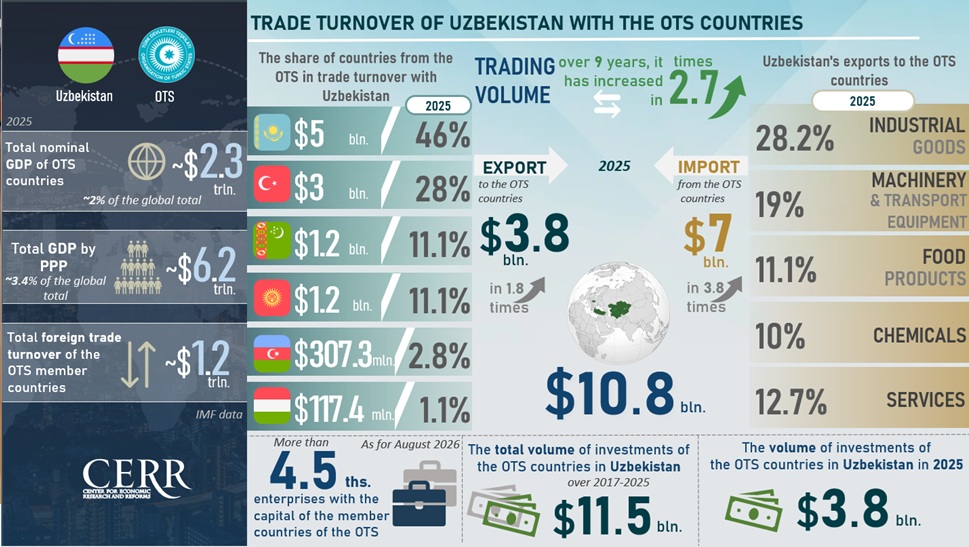
Uzbekistan has moved its economic cooperation with the Turkic states into a practical dimension
Ahead of the 13th Summit of the Organization of Turkic States, scheduled to be held in Ankara, economic cooperation within the OTS is acquiring new substance.
Water security in the turkic world: shared interests and common solutions
Water is a precious blessing that transcends national borders and has long connected peoples and civilizations.

Strengthening Transport Connectivity in Asia through the Development of the Trans-Caspian International Transport Corridor
Shifting international supply chains and expanding trade in Asia are driving demand for sustainable transport routes. For businesses, predictable delivery times, competitive rates, and reliable access to foreign markets are becoming increasingly important.