
Uniting markets and capital: the union of Uzbekistan and Turkey
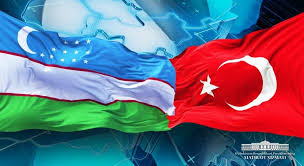
Over the past eight years, relations between Uzbekistan and Turkey have undergone a qualitative transformation, turning from traditionally friendly into a full-fledged strategic partnership with a pronounced economic and investment and industrial content. If the period before 2017 was largely inertial in nature, then, starting with the launch of large-scale reforms in Uzbekistan, the bilateral agenda was reformatted towards practical interaction focused on trade, investment and joint production.
The key role in this process was played by the political will and personal involvement of the leaders of the two states - the President of the Republic of UzbekistanShavkat Mirziyoyevand the President of the Republic of TurkeyRecep Tayyip Erdogan. It was the regular dialogue at the highest level that gave Uzbek-Turkish relations stability, consistency and a long-term economic horizon.
Political basis as a factor of economic rapprochement
Diplomatic relations between the two countries were established in 1992, but the turning point was October 2017, when the Joint Declaration on Strategic Partnership. This step laid the institutional foundation for a sharp expansion of trade, economic and investment cooperation.
In 2018, a High-Level Strategic Cooperation Council was created in Tashkent, co-chaired by the presidents of the two countries. Its meetings in 2020, 2022 and 2024 became a key platform for agreeing on priorities in the fields of trade, investment, industry, transport and interregional relations. Political dialogue has consistently evolved from declarative forms to a tool for supporting specific economic and project decisions.
Trade: scale, structure and institutional incentives
Turkey is confidently among Uzbekistan’s largest trading partners. In 2020, mutual trade turnover amounted to $2.1 billion, and at the end of 2025 it reached $3.02 billion.
Uzbekistan’s exports to Turkey are industrially oriented. It is based on non-ferrous metals and products made from them, textile products, services, plastics and food products. Imports from Turkey consist of mechanical and electrical equipment, chemical products, textiles, pharmaceuticals and metal structures, reflecting Turkey's role as a source of technology and industrial equipment.
A qualitative step forward was the signing of the Preferential Trade Agreement in 2022, which entered into force in 2023. In 2025, the parties began to expand the list of goods subject to preferential treatment, which creates additional incentives for diversifying trade and deepening production cooperation.
Investment cooperation: from presence to systemic participation
Investment cooperation is one of the most dynamically developing areas. In 2024, the volume of utilized Turkish investments in Uzbekistan amounted to $2.2 billion, and in January-November 2025 - already $3.2 billion. There are 2,137 enterprises with Turkish capital in the country, including 496 joint ventures and 1,641 enterprises with 100 percent Turkish participation.
Their areas of activity cover the textile and furniture industries, construction, trade, transport, logistics and services. It is fundamentally important that a significant part of these enterprises are export-oriented, which strengthens Uzbekistan’s involvement in regional and global value chains.
Industrial cooperation: transition to joint production
In recent years, Uzbek-Turkish cooperation has increasingly shifted from the model of classical trade to industrial cooperation. Turkish companies are actively involved in creating production capacities in the regions of Uzbekistan, introducing modern technologies, management standards and export practices.
Regular meetings of the Intergovernmental Commission on Trade and Economic Cooperation, accompanied by business forums, form concrete “road maps” with dozens of points covering industry, energy, logistics and regional projects. This lays the foundation for a sustainable industrial partnership.
Interregional cooperation: local economics
Active interregional interaction has become an important element of the new partnership model. In 2024, targeted visits of delegations from Fergana, Khorezm, Namangan, Navoi, Samarkand, Jizzakh regions and the city of Tashkent to the regions of Turkey took place.
This model allows the transition from framework agreements to specific investment projects, creates direct channels of B2B and B2G interaction and forms a decentralized, more sustainable architecture cooperation.
Transport and logistics as the backbone of trade and investment
The growth of trade and industrial cooperation objectively strengthens the role of transport and logistics interaction. Turkey is seen by Uzbekistan as a key logistics window to European and Mediterranean markets, while Uzbekistan is becoming an important gateway for Turkey to Central Asia.
The development of rail and road transportation, as well as intensive air traffic - up to 97 regular flights per week in eight directions - ensures business mobility, supports investment activity and strengthens the integration of the economies of the two countries.
Promising areas of cooperation: points of intersection of interests
The formed economic core of Uzbek-Turkish relations creates the basis for a new stage - the transition from quantitative growth to structural and technological deepening of cooperation.
The key point of intersection remains the localization and joint development of industrial production. Uzbekistan offers industrial zones, resources and a growing market, Turkey - technology, design, management solutions and access to external markets.
Textiles and light industryare evolving towards the production of finished branded products and contract manufacturing for international chains.
Mechanical engineering and electrical engineering form the prerequisites for the creation of assembly and manufacturing enterprises.
Agro-industrial complex opens up opportunities for deep processing and joint export of food products.
A separate strategic direction is becoming joint entry into the markets of third countries, where the combination of the production potential of Uzbekistan and trade and logistics infrastructure of Turkey creates significant competitive advantages.
In general, over eight years, Uzbekistan and Turkey have built a sustainable model of strategic partnership, which is based on trade, investment, industrial cooperation, interregional ties and transport connectivity. The growth of trade turnover to over $3 billion, multi-billion dollar investments and thousands of joint ventures indicate the maturity and long-term nature of bilateral relations.
Related news
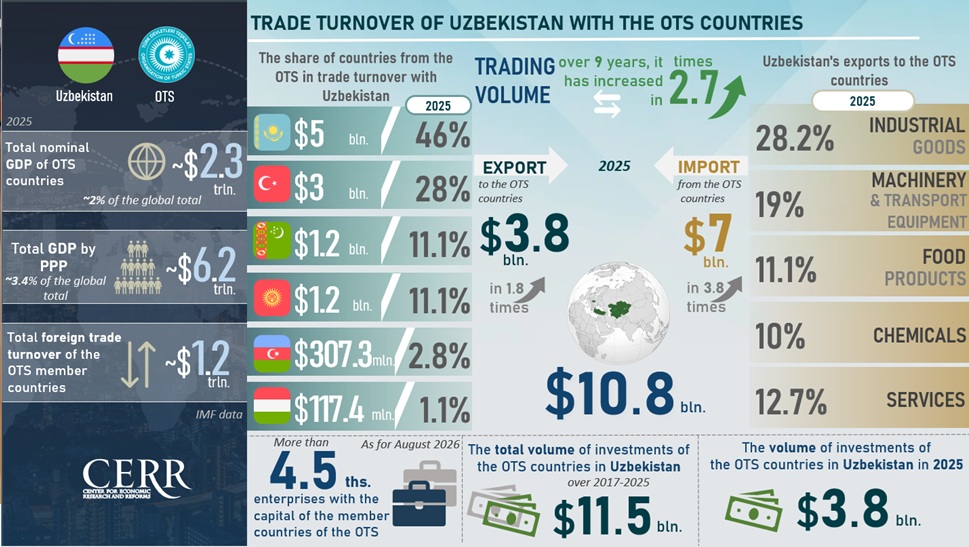
Uzbekistan has moved its economic cooperation with the Turkic states into a practical dimension
Ahead of the 13th Summit of the Organization of Turkic States, scheduled to be held in Ankara, economic cooperation within the OTS is acquiring new substance.
Water security in the turkic world: shared interests and common solutions
Water is a precious blessing that transcends national borders and has long connected peoples and civilizations.

Strengthening Transport Connectivity in Asia through the Development of the Trans-Caspian International Transport Corridor
Shifting international supply chains and expanding trade in Asia are driving demand for sustainable transport routes. For businesses, predictable delivery times, competitive rates, and reliable access to foreign markets are becoming increasingly important.