
New Uzbekistan: a “green” path of development

In the 21st century, green development has become not just a trend, but an uncontested vector for all humanity. In the context of rapid climate change, worsening water resource shortages and loss of biodiversity, sustainable development is a priority for every state. The President of the Republic of Uzbekistan Shavkat Mirziyoyev, speaking at international, regional and national platforms, regularly promotes the agenda of sustainable green development as an important tool for the prosperity of future generations.
The recently published book“The path of green development of New Uzbekistan”presents 310 quotes and 54 initiatives of the head of state put forward during the period 2017–2025 to combat climate change, rational use of water and natural resources, preserve biodiversity and transition to a green economy.
The book consists of three chapters: “Green development - the path chosen by humanity”, “Central Asia - a course towards green development and the future” and “New Uzbekistan on the path of sustainable development”.
The path chosen by humanity
In the context of the global climate crisis, depletion of natural resources and deteriorating environmental quality, more and more countries are moving to a model of sustainable development. In this concept, the green economy replaces raw material industrial models focused on extraction, exploitation and ignoring environmental risks.
The leader of Uzbekistan has repeatedly emphasized that for the countries of Central Asia, green development should become the basis of a new stage of modernization: “...Only by effectively using limited land and water resources, eliminating environmental problems, taking the path of green development, green economy and green energy, it is possible to ensure the sustainable development of the country and the well-being of the population. This is the only true way.” This quote reflects a fundamental rethinking of public policy: from narrow economic thinking to a strategic approach, where the focus is, in addition to profit and growth, nature conservation, ecosystem sustainability, and public health. That is why the President is promoting the thesis thatthe green course is not a fashionable trend, but a long-term necessity. Supporting the transition to green energy sources, reducing greenhouse gas emissions, strengthening environmental legislation and educating the public are all part of systemic green reform.
The leader of the state constantly emphasizes that responsibility for the future lies not only with developed countries, but also with countries with emerging economies. In this context, the President at the UN General Assembly (2023) stated: “At this critical moment in history, we should all think about what kind of planet we will leave to future generations.” This call is aimed at mobilizing the global community, but primarily reflects the internal transformation of Uzbekistan - a course towards sustainability, resource conservation and climate justice. Here are the scientifically based proposals of the head of state.
Firstly“climate change has become one of the main challenges for the sustainable development of Central Asia,” said the President of Uzbekistan at the COP28 summit in Dubai. “The transition to a green economy and achieving carbon neutrality is the strategic goal of New Uzbekistan.”.
Secondly, “climate change has become one of the main challenges on the path to sustainable development. This is especially acute in Central Asia and adjacent regions against the backdrop of the Aral tragedy - one of the most devastating environmental crises of our time."
Thirdly, "the increase in air temperatures in Central Asia is twice the global average, the number of extremely hot days has doubled, and a third of the glaciers have melted."
Fourth, “soil degradation, regular dust and sand storms, shortage of drinking water, air pollution, loss of biodiversity, sharp decline in crop yields and much more negatively affect the quality of life of millions of residents of the region.”
Fifth,The President also advocated for “early agreement on a Global Framework for Climate Change Adaptation under the Paris Agreement.” He also touched on the global transition to a low-carbon economy. According to him, this process “must be fair, transparent and inclusive” and “necessarily take into account the interests of developing countries.”
Sixth,to transform the Aral Sea region into a zone of environmental innovation, technology and new opportunities, the head of Uzbekistan invited everyone to close cooperation “to create an International Climate Expohub in this region technologies". The President proposed “to establish scientific exchange and conduct joint research on the platform of the Climate Scientific Forum,”created on the basis of the “Green University” in Tashkent, with the involvement of scientists and experts from foreign countries.
Central Asia - a course towards a safe future
Global climate change is one of the most serious problems of our time, which affects all countries and turns into a significant obstacle to sustainable green development. The observed warming is causing extreme natural events around the world, such as droughts, hurricanes, sweltering heat, fires, heavy rains, and floods.
Uzbekistan and other Central Asian states are among the countries that are most susceptible to environmental disasters. Against the backdrop of a general increase in climate threats, the region is developing its own response to the challenges of global warming and environmental degradation. The initiatives of the President of Uzbekistan at international platforms show thatgreen transformation is an interstate priority.
Speaking at the 78th session of the UN General Assembly (2023), the President emphasized: “Today there is an acute environmental situation in the world. The triple planetary crisis caused by climate change, biodiversity loss and pollution is intensifying. In such difficult conditions, Central Asia, which continues to struggle with the tragedy of the Aral Sea, becomes one of the most vulnerable regions to climate change.”
This quote indicates the need for regional integration in the field of environmental security. The importance of joint actions in the management of natural resources, in particular transboundary waters, was noted. The President initiated the development of a Regional Strategy to Combat Desertification and Land Degradation, emphasizing that sustainable agriculture and biodiversity conservation are possible only through concerted efforts.
As part of this course, the following initiatives were put forward: the creation of a Regional Center for Climate Technologies, the formation of a single green energy space, joint projects on reforestation and the fight against desertification, especially in the dry bottom of the Aral Sea, the development of transboundary water diplomacy based on the principles of the Helsinki Convention.
In recent years, at the initiative of Uzbekistan, the UN General Assembly has adoptedmore than tenspecial resolutions. Many of them directly relate to environmental issues inCentral Asiaand reflect the active role ofregional environmental diplomacy in Uzbekistan.
All international initiatives and efforts of the leader of Uzbekistan in this area are related to the national values passed on to us from our ancestors for thousands of years. Environmental initiatives of the head of state, presented at global forums, receive broad support from the international community and make a real contribution to ensuring sustainable green development at the global level.
For example, one of the landmark achievements of Uzbekistan was the adoption in 2021 of a Special Resolution of the UN General Assembly, declaring the Aral Sea region a zone of environmental innovation and technology. This is the first time that the assembly has granted such a high status to the region. As a result of the drying up of the Aral Sea, the Aral Sea region has become the epicenter of a global environmental disaster, an area with an increased risk to human health and ecosystem instability.
Issues of water resource management in the region also do not remain out of the sight of President Shavkat Mirziyoyev. “Effective management of water resources with neighboring countries is the key to sustainable development not only of Uzbekistan, but also of our entire region.” This thesis is especially relevant for Central Asia, where water is becoming an increasingly scarce and politically sensitive resource. The leader of the state advocates the creation of sustainable mechanisms for the distribution and joint management of water flows, which should reduce tensions and ensure harmonious development.
At the SCO summit in Bishkek (June 14, 2019), Shavkat Mirziyoyev proposed adopting the SCO Green Belt program with the aim of introducing resource-saving and environmentally friendly technologies in the organization’s countries. At the 14th ECO summit (March 4, 2021), the head of Uzbekistan took the initiative todevelop and approve a medium-term strategy aimed at ensuring energy sustainability and widely attracting investments and modern technologies in this area.
At the third Consultative Meeting of the Heads of State of Central Asia on August 6, 2021 in Turkmenistan, the President of Uzbekistan spoke for the development of a regional program “Green Agenda” for Central Asia, which will contribute to the adaptation of the countries of the region to climate change. Its main directions could be the gradual decarbonization of the economy, rational use of water resources, implementation into the economy of energy-efficient technologies, increasing the share of production of renewable energy sources.
Against the backdrop of updating the international climate agenda, the ongoing systemic environmental policy of Uzbekistan in the field of environmental protection is aimed at further improving the environmental situation in the Central Asian region.
Formation of environmental awareness and culture
Uzbekistan is actively integrating the principles of green transformation into its development strategies, creating the basis for long-term sustainable growth. This is a response to global challenges, a desire to improve the quality of life of our citizens, create jobs and contribute to the sustainable green development of the country. Green development in Uzbekistan has been raised to the level of a national movement. The main goal of New Uzbekistan's transition to a green course is to ensure human dignity, improve the well-being of the population and protect the fundamental rights of citizens.
For Uzbekistan, the transition to green development is not something abstract or far from reality. This concept has become part of the constitutional course of our country, which concerns all sectors of the economy and public life.
President Shavkat Mirziyoyev notes: “The accelerated transition to an economy that is based on careful use of water, energy and other natural resources is important.
The task of creating green and digital technologies and manufacturing enterprises is also relevant for us.”.
This is not just a scientific and philosophical statement, but a guiding principle of state environmental policy. Under this slogan, programs are being developed:
to increase the share of renewable energy (the goal is at least 30 percent by 2030);
to reduce water losses in the agricultural sector using digital systems and precision farming;
to increase the energy efficiency of residential and industrial fund;
for the creation of smart and green cities, including within the framework of the project "Tashkent - Green Capital".
One example is the construction of solar and wind power plants in Navoi, Bukhara and Samarkand regions. These projects are being implemented with the participation of large foreign investors (Masdar, ACWA Power) and open jobs, while reducing the burden on hydrocarbon resources.
The head of state also emphasizes the need to educate new environmental thinking among young people: “Understanding nature, environmental education and upbringing, the formation of environmental consciousness and environmental culture among the population, especially among young people, who call for kindness, compassion and mercy, are some of the important tasks that need to be accomplished to preserve the environment.”.
In this context, special attention is paid to environmental education, popularization of sustainable practices, support for start-ups in the field of eco-technologies and green innovations. The creation of a national ranking of the environmental performance of regions and institutions has become a tool for stimulating sustainable change.
Uzbekistan is becoming an example of a systematic approach to sustainable green development, combining environmental goals with economic growth and social justice. The principles of the green economy are increasingly integrated into national planning, which makes Uzbekistan not only a participant, but also an active driver of the international green agenda.
Conclusions: further prospects
First conclusion.The approach implemented in New Uzbekistan under the leadership of President Shavkat Mirziyoyev, represents an example of the synergy of political will, scientific knowledge, national policies and international cooperation. Green development is not a fad or a temporary solution. This is a strategic choice, a path chosen by humanity, and Uzbekistan demonstrates how this path can be implemented in the face of global challenges.
Second conclusion. The initiatives and statements of the leader of Uzbekistan demonstrate that green development for Uzbekistan is not a temporary agenda, but a strategic vector for a promising future. The architecture of an environmentally responsible state is being consistently formed with new laws, institutions, technologies and the consciousness of citizens.
Third conclusion. A feature of the Uzbek approach is its complexity: from global leadership in climate diplomacy to the practical transformation of energy, land use and water management. Shavkat Mirziyoyev voices the principles of sustainable development, and also ensures their institutional consolidation, investment and public support.
Fourth conclusion: The path to a green future proposed and implemented by New Uzbekistan can serve as a model for countries with similar challenges and opportunities. This is the path where economic progress goes hand in hand with care for the planet, where political will turns into concrete steps, and sustainability becomes the new norm for human development.
Akmal Saidov,
academician,
Deputy of the Legislative Chamber
Oliy Majlis of the Republic of Uzbekistan
Related news
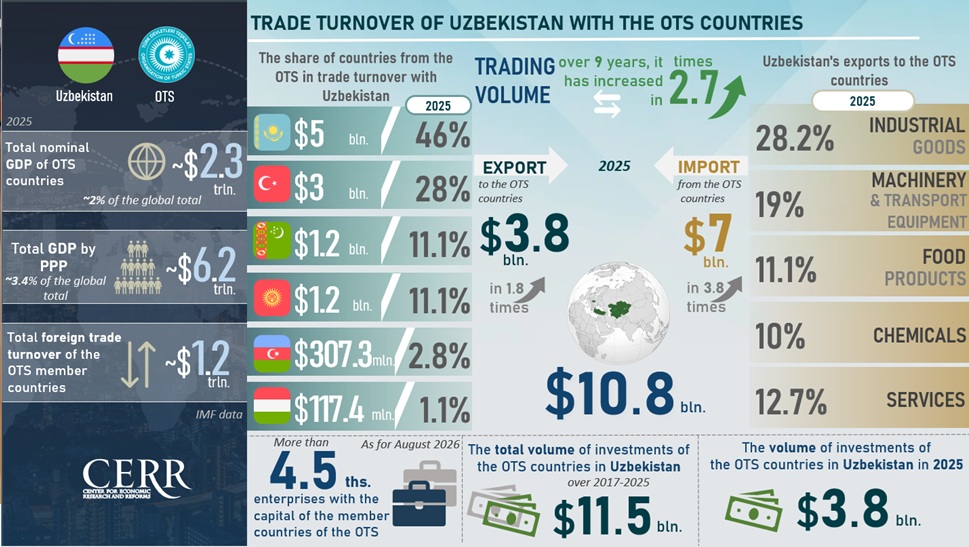
Uzbekistan has moved its economic cooperation with the Turkic states into a practical dimension
Ahead of the 13th Summit of the Organization of Turkic States, scheduled to be held in Ankara, economic cooperation within the OTS is acquiring new substance.
Water security in the turkic world: shared interests and common solutions
Water is a precious blessing that transcends national borders and has long connected peoples and civilizations.

Strengthening Transport Connectivity in Asia through the Development of the Trans-Caspian International Transport Corridor
Shifting international supply chains and expanding trade in Asia are driving demand for sustainable transport routes. For businesses, predictable delivery times, competitive rates, and reliable access to foreign markets are becoming increasingly important.