
New Uzbekistan: on the path to global social justice (Based on the results of the Second World Summit on Social Development)
Against the backdrop of deepening global challenges - from rising hunger and poverty to climate instability, theSecond World Summit on Social Security took place in Doha on 4-6 November 2025 development. In a context of growing inequality, demographic change and rapid technological and environmental transformation, the World Summit provided a critical platform for global dialogue and joint action.
The second summit in the capital of Qatar brought together more than 40 heads of state and government, 170 ministers, heads of international organizations, youth leaders, civil society representatives and experts - in total over 14 thousand participants to discuss social development issues at the highest level and advance social progress, ensuring that no one is left behind on the path to sustainable development on a global scale.
As is known, the UN General Assembly in 2024, through its resolutions 78/261 and 78/318, decided to convene the Second World Summit on Social Development in 2025, designed to reaffirm commitment to theCopenhagen Declaration on Social Development and Agenda of Actionand their implementation, and provide impetus to the implementation of the 2030 Agenda for Sustainable Development.
Outcome of the First World Summit on Social Development
In 1995, at the first World Summit on Social Development, world leaders adopted theCopenhagen Declaration and Program of Actionthat introduced the Ten Commitments - a framework for ending poverty, promoting full employment and building inclusive, equitable and sustainable societies. Social protection is central to the Copenhagen Declaration and a powerful driver for poverty reduction, equality and shared prosperity. Strengthening universal, inclusive and sustainable social protection systems is essential to realizing the right to social security and promoting social justice.
Over the past period, the international community has also made a number of commitments in the field of social development, in particular:
firstlyin 2000- the Millennium Development Goals (MDGs) to address issues of poverty, health and education;
secondlyin 2015 - the Sustainable Development Goals (SDGs), which outline the path to a more equitable and sustainable future;
thirdlyin 2017 - the Third United Nations Decade for the Eradication of Poverty (2018–2027) to effectively and coordinated support for the implementation of internationally agreed development goals related to poverty eradication;
Fourthin 2021, the Common Agenda, which called for renewed inclusive multilateral cooperation;
Fifth, in 2024 – thePact for the Future, which includes the Global Digital Compact and theDeclaration on Future Generations, and covers issues of peace and security, sustainable development, climate change, digital cooperation, human rights, gender issues, youth and future generations.
Globally, 35 percent of the 137 Sustainable Development Goal targets are either on track or with moderate progress, according to the UN. Completion of 47 percent of tasks is not progressing at a fast enough pace, and 18 percent of tasks show regression compared to the baseline indicators of 2015.
Progress on several of the Sustainable Development Goals has been uneven and limited, but notable achievements are being made across all regions and countries, demonstrating that change is possible. Since the adoption of the Copenhagen Declaration, global unemployment rates have fallen over the past decades, and extreme poverty rates have been halved.
Over the past three decades, 1.5 billion people have been lifted out of poverty. Thus, since 2015, the level of extreme poverty around the world has fallen, despite the serious consequences of the global pandemic, and the number of people classified as working poor has decreased by 20 million. Health indicators have also improved: in 2024, global life expectancy at birth reached 73.3 years. This increase of 8.4 years since 1995 is the result of improved access to primary health care, immunization and disease control measures, and improved child nutrition. For the first time, more than half the world's population is covered by at least one social protection benefit
(52.4 percent), which is more than the 2015 figure of 42.8 percent. The rate of young people completing senior secondary school has increased from 53 percent in 2015 to 60 percent in 2024, and literacy rates have increased. In addition, there has been a steady narrowing of the gender gap in education.
However, serious challenges remain: the UN Development Program estimates thatabout 800 million people still live in extreme poverty. Bover a billion people around the world still live in poverty, and 40 percent of the world's population lacks access to social protections. Significant inequalities continue to exist, particularly affecting women and youth. Economic growth alone is not enough to overcome structural inequalities; they are exacerbated by climate change, demographic challenges and conflict.
Technology is accelerating the erosion of social cohesion and trust. Digital platforms are increasing opportunities to stay connected, but they are also increasing the impact of disinformation and hate speech.
Second World Summit on Social Development
30 years after Copenhagen, the Second World Summit in Doha symbolizes a renewed global resolve to leave no one behind and give everyone - regardless of age, ability, gender or background - the opportunity to live with dignity and have a chance to develop.
World leaders adopted the Doha Political Declaration at the Second World Summit on Social Development, reaffirming the global commitment to building fairer and more inclusive societies. The document emphasizes thatsocial development is not only a moral imperative, but also a necessary condition for peace, stability and economic growth.
On the sidelines of the Summit, discussions took place within the framework of the Social Development Solutions Forum and the first meeting of the leaders of the Global Alliance against Hunger and Poverty, the high-level event “Education as the basis of a new social contract”, as well as Civil Society Forum, Private Sector Forum and the interactive “Solutions Square”.
Today, more than 670 million people suffer from hunger and 2.3 billion are food insecure. The first high-level meeting of the Global Alliance Against Hunger and Poverty emphasized that the crisis is not due to food shortages, but to “inequality, conflict and misguided policies.” The Global Alliance, created in 2024 under Brazil's presidency of the G20, includes almost 200 participants - governments, regional associations, international organizations and civil society structures. The goal of the meeting is to strengthen coordination within the alliance: expand social protection, support agriculture and invest in climate-resilient agriculture. It is a global call to action, reaffirming the commitment of governments to create “an enabling economic, political, social, cultural and legal environment to achieve social development for all.”
The Global Coalition for Social Justice Forum highlighted that initiatives to raise living wages, respect fundamental principles and rights at work, strengthen social dialogue, expand social protection coverage, create forward-looking training systems, contribute to eradicating poverty, creating decent jobs and stimulating social transformation and social inclusion.
Today, high-income countries spend about 16 percent of GDP on social protection (excluding health care). By comparison, spending in low-income countries is 1 percent of GDP, suggesting the need to increase investment. The commitment recommends that countries aim to expand coverage by 2 percentage points per year.
Education plays a key role in breaking the cycle of poverty, building the skills needed for decent work, and promoting equity and inclusion. Yet despite the progress, millions of children are still out of school, and global crises, including conflict, climate change, pandemics and the digital divide, are erasing hard-won gains. The Social Summit Political Declaration calls for the integration of quality education as a key component of poverty reduction strategies as part of a lifelong learning approach. The Declaration also highlights the importance of skills needed for the transition to a green and digital economy, which are vital for future labor markets.
The Doha Political Declaration reaffirms the international community's commitment to the principles of the 1995 Copenhagen Declaration and the 2030 Agenda for Sustainable Development. The Declaration sets out three mutually reinforcing areas of work: ending poverty, ensuring employment and decent work for all, and creating more inclusive societies. The Declaration links social justice to peace, security and human rights and calls for urgent action on climate change.
The Doha Declaration calls for comprehensive, interconnected solutions covering poverty and hunger, education, health, climate resilience and gender equality. Monitoring the implementation of the declaration's provisions is entrusted to the Commission for Social Development of the UN Economic and Social Council (ECOSOC).
UN Secretary-General Antonio Guterres emphasized that “The Doha Political Declaration is an impetus for development, a plan for people to expand universal social protection, ensure equal access to health and education and overcome digital gap". The UN Secretary General noted the urgent need to reform the global financial architecture to ensure access to financing for development and climate initiatives, especially for developing countries experiencing debt difficulties.
New Uzbekistan: international initiatives for global social development
President of Uzbekistan Shavkat Mirziyoyev, speaking at the Second World War Summit on Social Development, presented a number of proposals and initiatives aimed at strengthening global social justice and sustainable development. The speech of the head of Uzbekistan notes that “the world community and national governments act together to ensure social well-being and improve the lives of the population. Uzbekistan consistently supports all formats and initiatives of international cooperation aimed at sustainable development.” It was emphasized that in New Uzbekistan a society is being built in which the priorityprinciple “In the name of the honor and dignity of man” is affirmed, social justice and effective protection of the needy population are ensured.
In the context of complex socio-economic processes occurring in the world, the President of Uzbekistan put forward a number of new initiatives and proposals aimed at strengthening global social policy.
The first initiative is thecreation of the Global Fund for Social Justice. According to the UN, today more than 1.1 billion people around the world live in poverty. More than 70 percent of government spending in Uzbekistan is directed specifically toward achieving the Sustainable Development Goals. Based on the study of positive practices in the world, a model of New Uzbekistan for poverty reduction was created. First of all, targeted social notebooks have been introduced (“Iron Notebook”, “Women’s Notebook”, “Youth Notebook”, “Mercy Notebook”), which are an important tool for the transition period, thereby covering all families in need. As a result, guaranteed social protection covered more than 2.3 million needy families, women, the elderly and disabled. This is four times more than in 2017.
Globally, developing countries need more than $4 trillion to achieve the Sustainable Development Goals. In such conditions, there is a need for a “new financial architecture to combat poverty” to objectively assess risks, attract financial resources to social programs of developing countries, and increase their efficiency. In order to find solutions to these issues, the President of Uzbekistan also proposesto hold a high-level Conference in Khiva in 2026 with the participation of international financial institutions, donor organizations and partner states.
The second initiativeis development of the Global Initiative on Social Responsibility and Decent Work. According to an ILO report, the global unemployment rate was 5 percent in 2024. The rapid introduction of high technologies and artificial intelligence is leading to the loss of millions of jobs around the world. In such conditions, governments and businesses as social partners must pay great attention to supporting employees.
It should be noted that over eight years, $130 billion of investments have been attracted to the economy of Uzbekistan, thousands of new facilities have been launched, and millions of permanent jobs have been created. An important factor is that over the past period the national economy has doubled, and per capita income will reach $3.5 thousand by the end of the year. To ensure the rights and freedoms of every person, labor protection, access to guaranteed social protection, a strong legislative framework has been created, including the adoption of an updated Constitution, a new edition of the Labor Code, laws “On Employment”, “On Trade Unions”.
The third initiative - holding a summit of the Global Alliance to Combat Hunger and Poverty in Uzbekistan, placing the issue of education at the top of the agenda. Today, the annual economic cost of illiteracy is estimated at US$1.4 trillion. For the younger generation, this makes it difficult for the younger generation to find their place in social life and in the labor market, leading to a sharp increase in inequality.
Uzbekistan has officially joined the Global Alliance to Fight Hunger and Poverty, which is an important step towards strengthening global efforts to achieve sustainable development goals and improve food security in the country. This step was taken in response to growing challenges to global food security and Uzbekistan's desire to actively participate in solving problems related to hunger, poverty and inequality. Participation in the Global Alliance provides the country with unique opportunities to exchange experience, attract international investment and implement joint programs with other states and organizations to solve these pressing problems.
The fourth initiative– conducting the International Forum on the social and legal protection of migrants and their families in Uzbekistan and the adoption of the Global Program. Currently, more than 300 million migrants worldwide work in foreign countries. Unfortunately, there are many cases of violation of their rights. In this regard, ensuring safe and legal migration processes in the context of globalization is a multifaceted task, including for the Republic of Uzbekistan, which requires an in-depth analysis of various influencing factors and their consequences.
New Uzbekistan has launched a process of large-scale transformations that determine the long-term trajectory of the development of the country's social and political life, including reforms in the labor market, in particular in the field of external labor migration. This is confirmed by the amendments made to the Constitution of Uzbekistan, the purpose of which is to strengthen measures to protect the labor rights of citizens of the country. A unique mechanism has been created to ensure the safety, legality and convenience of the migration process for citizens, which includes three main areas: preparation, language and professional skills training for citizens; protecting the rights and freedoms of compatriots who are abroad as labor migrants, providing them with material and moral assistance; ensuring employment for citizens returning after labor migration, creating conditions for their social reintegration, in particular, adaptation to the social environment.
Qualityeducation will remain the main driver of human capital development and poverty reduction in the long term. As kindergarten enrollment increased from 27 percent to 78 percent, 1 million women now have the opportunity to further their education, learn a profession, and earn an income. Over the past five years, more than 800 thousand citizens have been trained in modern professions and employed in highly profitable jobs. In order to create a unified international platform for the exchange of experience and knowledge of teachers, it is proposed to hold the World Summit of Professional Education in Uzbekistan.
The fifth initiative is thelaunchof a newmodel of socio-economic development in the Aral Sea regiondeclared by the UN resolution as an environmental innovation zone and technologys. Extreme weather, desertification and biodiversity loss primarily impact the lives of vulnerable populations, farmers, seasonal workers and residents of environmentally sensitive regions. A very urgent task is to take comprehensive measures to harmonize the fight against climate change with employment programs.
In 2024, for the first time, the global average temperature increased by more than one and a half degrees Celsius. The last decade has been the hottest in the history of meteorological observations. As a result, we all today feel the negative impact of climate crises - increasing forest fires and desertification, shrinking glaciers, growing shortage of water resources, deteriorating air quality.
In this regard, active work is being carried out to restore the Aral Sea ecosystem. In recent years, salt-tolerant desert plants have been planted on the dry bottom of the Aral Sea with a total area of 2 million hectares. By 2030, up to 80 percent of the entire territory will be covered with green spaces.
It should be noted thatthe countries of Central Asia have developed and unanimously approved a Climate Change Adaptation Strategy. Uzbekistan successfully cooperates with international partners within the framework of programs to mitigate the consequences of the drying up of the Aral Sea, rational water use, and expanding the share of “clean” energy sources. In order to reduce the area of degraded land and mitigate the effects of climate change, large-scale landscaping is being carried out as part of the Yashil Makon project.
The participation of President Sh. Mirziyoyev at the Second World Summit on Social Development further emphasizes the importance of the youth policy of New Uzbekistan. Back in September, speaking at the UN General Assembly, the head of Uzbekistan put forward an initiative tocreate a World Youth Movement for Peace with headquarters in Tashkent. The country demonstrates high rates of economic growth, is one of the ten countries actively implementing the UN Youth 2030 strategy, and is a leader in progress in youth policy.
The President of Uzbekistan again notes that it is necessary to “restore public harmony on the path of international development, create a decent standard of living for every person.” Uzbekistan fully supports the Doha Political Declaration adopted at the summit and is ready to actively participate in its implementation.
New Uzbekistan: a constitutional social state
The Constitution of the Republic of Uzbekistan in the new editionenshrines the principle of a social state. Thus, Article 43 of the Basic Law states that the state ensures employment of citizens, protects them from unemployment, takes measures to reduce poverty, organizes and encourages vocational training and retraining of citizens.
It should be noted that the key tasks and measures for poverty reduction and social protection are firmly established in legislation and government strategies. The national program “From Poverty to Prosperity” is being successfully implemented. In particular, to carry out this activity, on the basis of combining the powers previously assigned to 6 state organizations, the National Social Protection Agency and Inson social service centers were created.
Thus, according to the Strategy “Uzbekistan - 2030”, by 2026 the poverty level is planned to be halved compared to 2022, and by 2030 - to increase the incomes of 4.5 million people at risk of falling into poverty, and to train 500 thousand qualified specialists on the basis of social partnership.
Over the past 8 years, more than 7 million people have been lifted out of poverty in the country, and the poverty rate has dropped from 35 percent to 6.6 percent. This year alone, social services and assistance were provided to 2 million 700 thousand citizens. In particular, new types of social services have been established for members of poor families in need of care, and work opportunities have been created for 50 thousand able-bodied citizens.
It should be emphasized that the New Uzbekistan, increasingly opening up to the world, following the path of accelerated social reforms, firmly follows the principle“the state is for the people”and is becoming an integral part of global changes. Our country is among the top five most progressive countries according to the Global Sustainable Development Goals Index. A new five-year program of cooperation with the UN in the context of achieving the SDGs was signed. Together with international partners, a number of events on a planetary scale were held, in particular, the 150th Assembly of the Inter-Parliamentary Union on the theme “Parliamentary action in the interests of social development and justice”, the III International Forum “From Poverty to Prosperity”, the Samarkand International Climate Forum.
Today more relevant than ever acquires the exchange of advanced international experience in implementing UN Sustainable Development Goals, promoting digital transformation, applying innovative solutions in the provision of public services, and radically increasing the efficiency of public administration institutions. UN member states took steps to strengthen solidarity by adopting the Pact for the Future and committing to “a new beginning for multilateralism” based on a more inclusive and effective multilateral system.
The outcome of the Second Summit demonstrates that this meeting will serve as a catalyst for achieving new global policy consensus, consolidating commitments and strengthening multilateral engagement to create the basis for a sustainable transition towards equity, solidarity and shared prosperity. It is mobilizing the political will to invest in human potential and ensure universal access to basic services that is the key to ending poverty, reducing inequality and leaving no one behind.
Akmal Saidov
Deputy of the Legislative Chamber
Oliy Majlis Republic Uzbekistan
Related news
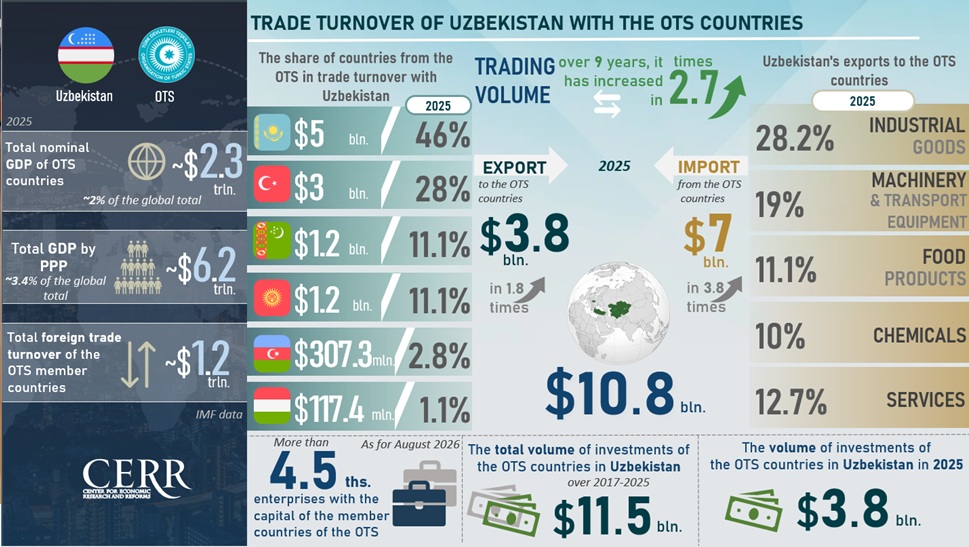
Uzbekistan has moved its economic cooperation with the Turkic states into a practical dimension
Ahead of the 13th Summit of the Organization of Turkic States, scheduled to be held in Ankara, economic cooperation within the OTS is acquiring new substance.
Water security in the turkic world: shared interests and common solutions
Water is a precious blessing that transcends national borders and has long connected peoples and civilizations.

Strengthening Transport Connectivity in Asia through the Development of the Trans-Caspian International Transport Corridor
Shifting international supply chains and expanding trade in Asia are driving demand for sustainable transport routes. For businesses, predictable delivery times, competitive rates, and reliable access to foreign markets are becoming increasingly important.