
The new Uzbekistan, even in the context of a complex historical heritage, strives for a more equitable and transparent structure

After gaining independence in 1991, Uzbekistan for a long time retained elements of a centralized management system characteristic of post-Soviet countries. However, since 2016, the country has entered a new stage of development, marked by structural reforms aimed at democratizing society, reducing corruption and improving conditions for civic participation.
Reforms are associated not only with internal challenges, such as the need to improve the standard of living of the population, but also with the country’s desire to integrate into the world economy and strengthen its reputation in the international arena. These reforms are actively discussed both in scientific circles and among political analysts.
Since 2016, Uzbekistan has demonstrated a consistent strategy of institutional reforms. According to professor of Tashkent State University Abdullaev A.A., “the country is in the midst of unprecedented socio-political changes aimed at radical modernization of all spheres of public life.”
The key trend of modern Uzbekistan is the consistent democratization of the political system. Expanding the powers of parliament and creating a multi-party system are not formal steps, but deep institutional changes.
Today, the main direction of reform is the transition to a more equitable system in Uzbekistan, which begins with reforms in the public administration system. An expert in the field of public law, Professor Kh. Islamkhodjaev notes that one of the key tasks is decentralization, which allows regions to make more independent decisions. This will directly allow for a deeper expansion of the regions’ independence in solving problems and building open government governance.
Also, the introduction of e-government played an important role in improving public administration. This step increased the transparency of government services and made them more accessible to citizens. According to S. Karimov’s research, electronic services have made it possible to reduce the level of corruption by eliminating the human factor at many stages of interaction. So, in the opinion of Z. Ulmashuzhaev, “Electronic government” is an organizational form of public administration that takes into account the interests of citizens, which is intended to provide services to the population by public authorities, ensure openness and transparency of the activities of public authorities and management using information and communication technologies.
The peculiarity of the development of public administration in this industry was also noted by the general manager of Samsung, Jung Hyun Chang: “The e-government system is developing rapidly in Uzbekistan. This is a reflection of the development of innovative technologies in the country, their implementation in all areas of activity.”
Thus, fundamental changes and such innovations made it possible to implement the policy of openness of government power. The new policy requires government agencies to report regularly to the public. The introduction of public hearings and platforms for discussing bills strengthens civil participation in governance.
Of course, the fight against corruption has a special role in the pursuit of fairness and transparency in the state structure, since, according to S. M. Rakhimov, corruption is one of the main barriers to building a fair society. To combat this phenomenon, Uzbekistan has adopted a National Anti-Corruption Strategy, and also created a special Anti-Corruption Agency.
Also, the introduction of the law “On Anti-Corruption” played an important role; this law identified the following priority areas:
– Expansion of anti-corruption mechanisms;
– Strengthening the responsibility of officials;
– Creation of a transparent system declaration of income.
Also, the creation of a fair and transparent judicial system plays an important role. Professor of Legal Sciences D. Suyunova emphasizes that an effective judicial system is the basis of a fair society.
Increasing the independence of the courts. Reducing the influence of the executive branch on the judiciary and carrying out personnel reforms have created a more equal playing field for justice.
To achieve this goal, key changes have been made to legislative acts:
1. Law “On the Courts” (new edition 2021)
– Strengthening the independence of the judiciary;
– Introduction of electronic justice;
– Expanding the competitiveness of judicial proceedings.
2. Changes in the Criminal Procedure Code
– Humanization of criminal legislation;
– Strengthening guarantees of the rights of suspects and accused;
– Introduction of jury trials.
3. Law “On Guarantees of Citizens' Rights in the Judicial System”
– Expanding judicial protection of rights;
– Simplifying access to justice;
– Introduction of free legal assistance.
This activity has significantly increased fairness both at the pre-trial stage and at the trial stage. The independence of judges in their activities was significantly expanded, subordinating only to the law. Also, the importance of improving the judicial system is noted by many modern legal scholars: “modernization of the judicial system is not only technical changes, but also the formation of a new legal culture. The introduction of digital technologies and the principle of adversarial proceedings radically changes approaches to justice."
Thus, one can note the significant importance and role of improving the judicial system on the path to building a fair society in the state.
Uzbekistan’s desire for a fair and transparent structure is a significant step in the development of the country. The reforms have already brought important results, but for their sustainability it is necessary to continue working on strengthening institutions, developing civil society and legal culture.
Consequently, the progress of Uzbekistan can become an example for other countries, showing that even in the conditions of a complex historical heritage, it is possible to build a society based on justice and transparency.
Sardorjon Zokirov,
Lecturer, Department of Criminal Procedure Law
Tashkent State Law University
Related news
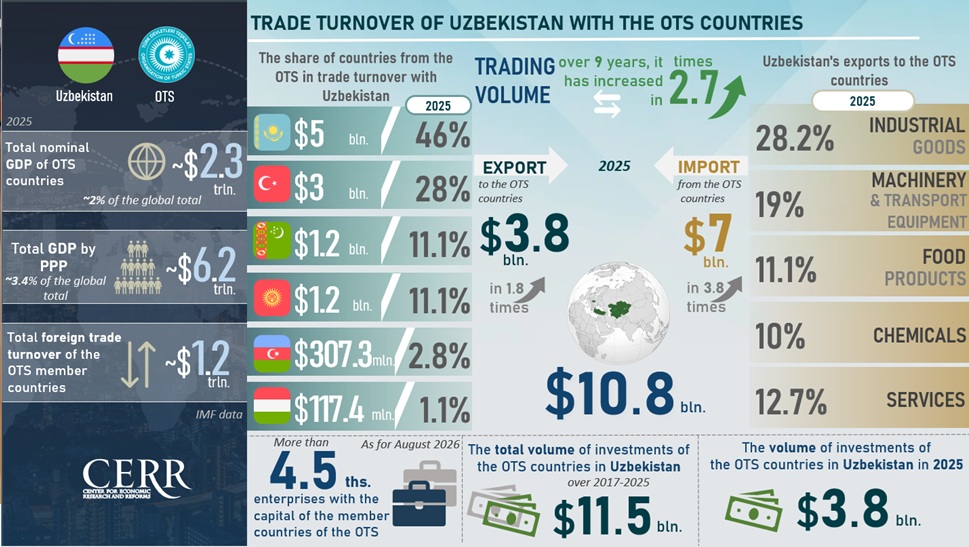
Uzbekistan has moved its economic cooperation with the Turkic states into a practical dimension
Ahead of the 13th Summit of the Organization of Turkic States, scheduled to be held in Ankara, economic cooperation within the OTS is acquiring new substance.
Water security in the turkic world: shared interests and common solutions
Water is a precious blessing that transcends national borders and has long connected peoples and civilizations.

Strengthening Transport Connectivity in Asia through the Development of the Trans-Caspian International Transport Corridor
Shifting international supply chains and expanding trade in Asia are driving demand for sustainable transport routes. For businesses, predictable delivery times, competitive rates, and reliable access to foreign markets are becoming increasingly important.