
Linguistic analysis of the Address of the President of the Republic of Uzbekistan for 2026
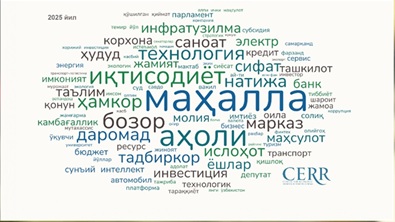
December 26, 2025 President Shavkat Mirziyoyev delivered a message to the Oliy Majlis and the people of Uzbekistan. Experts from the Center for Economic Research and Reforms(CERR)conducted a linguistic content analysis of the speech of the head of state.
The analysis was carried out using modern linguistic methods and is aimed at identifying semantic accents, key concepts and their relationships. A word cloud and diagrams have also been prepared that clearly reflect the priority areas of government policy.
Analysis (from the original language)
The President used a total of 9,135 words in his Address. The creation of a word cloud made it possible to visualize the most significant topics and gain a deeper understanding of the priorities and directions of the country’s socio-economic development.
Linguistic analysis showed that the most frequently used keywords were “mahalla” - 49 times, “aholi” (population) - 35 times, “ iqtisodiyot" (economy) - 28 times, "bozor" (market) - 26 times, "loyiha" (project) - 25 times, "technology" - 22 times. (Fig. 1)
Words such as “talim” (education), “natizha” (result) and “daromad” (income) were used 20 times each, “tadbirkor” (entrepreneur) and “sanoat” (industry) 19 times each, “suv” (water) - 18 times, “electr” (electricity) and “hudud” (territory) 17 times each, “yoshlar” (youth), “infratuzilma” (infrastructure) and “ Kurilish" (construction) - 16 times.
Analysis of two-word expressions showed that the phrase “Markaziy Osiyo” (Central Asia) was used 8 times, “aholi daromadi” (income), “qishlok hўzhaligi” (agriculture) and “yangi boskich” (new stage) - 7 times each, “Yangi Tekhnologiyalar” (new technologies) and “Tashkent Shakhri” (city of Tashkent) - 6 times each. The expressions “Davlat hizmatlari” (public services), “horizhiy investment” (foreign investment) “yangi tizim” (new system) were used 5 times, “dual talim” (dual education), “ish urni” (jobs), “viloyat markazlari” (regional centers) and “budget fog” (district budgets) 4 times each.
Among three-word constructions, the most frequently used formulations were “the coming five years” - 9 times, “based on dual education” - 4 times, “water-saving technologies”, “water, electricity” - 3 times each.
Thus, the analysis shows that the center of state policy is the mahalla, the welfare of the population and the transition to a new stage of development based on economic and technological transformations, with clearly defined strategic objectives for the next five years.
Thematic structure of the speech
Below is a diagram of the distribution of speech vocabulary in the main areas where the content of the speech grouped into 9 main thematic blocks.
The diagram clearly demonstrates that technological development and human interests, implemented at the mahalla level, are at the center of state policy. The ultimate goal of all reforms is to ensure the well-being of the population through sustainable economic growth.
Interrelation of development directions
The presented analysis highlights key words that show the relationship between various directions of state policy of Uzbekistan in the coming years.
The transition of the economy to a technological and innovative growth model is a central element of state policy and involves the abandonment of the raw materials model in favor of the high-tech industry. This area is closely related to such concepts as “investment”, “technology”, “market” and “product”.
The block of economic growth and welfare reflects the key results of the reforms, including economic growth to $145 billion and a halving of the poverty level over the past three years and is directly related to “population”, “economy”, “mahallas” and “services.”
The social foundation of reforms is formed through the development of mahallas and social solidarity. This direction is associated with the concepts of “makhalla”, “youth”, “society” and “values”.
Structuring the vocabulary into areas showed that the center of the speech is the technological modernization of the economy and a human-oriented management model based on the “mahallabay” system.
The relationship of economic growth with improving the well-being of the population and the development of local infrastructure is emphasized, as well as priorities for strengthening human capital, expanding employment and increasing the efficiency of public administration.
The identified semantic blocks also include the tasks of stimulating domestic demand, developing housing and tourism direction, modernization of the transport system, increasing productivity in agriculture and the introduction of water-saving technologies.
Special emphasis is placed on the “green” agenda, including the development of renewable energy, expansion of the Yashil Makon initiative, as well as increasing resilience to climate risks.
The foreign policy block emphasizes the openness of Uzbekistan, strengthening good neighborly relations and integration into the global economic system.
Linguistic analysis confirms that the basis of the speech of the head of state is formed around the link “inson qadri - mahalla - farovonlik” (human dignity - mahalla - growth of well-being), where the goal of the reforms is designated as sustainable growth, improving the quality of life of the population and further strengthening the position of Uzbekistan.
Iles Rabbimov, CEIR
CEIR Public Relations Service
Related news
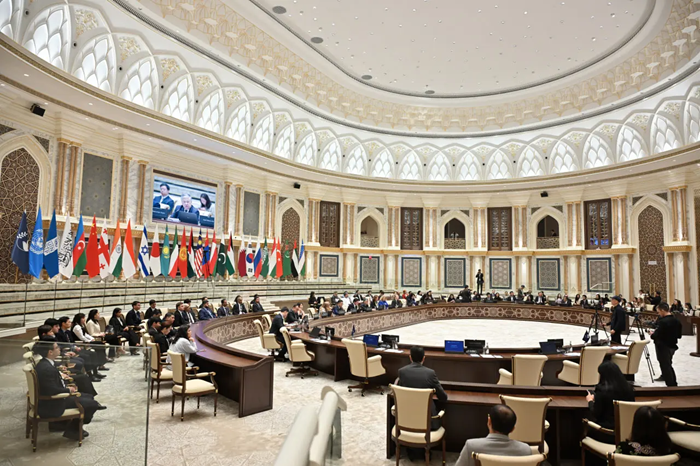
Tashkent Hosts the Tech Diplomacy Asia Symposium
On October 14, 2026, the Tech Diplomacy Asia Symposium was held at the Center of Islamic Civilization in Uzbekistan. The event was jointly organized by the Ministry of Foreign Affairs of the Republic of Uzbekistan and the Tech Diplomacy Global Institute (TDGI).
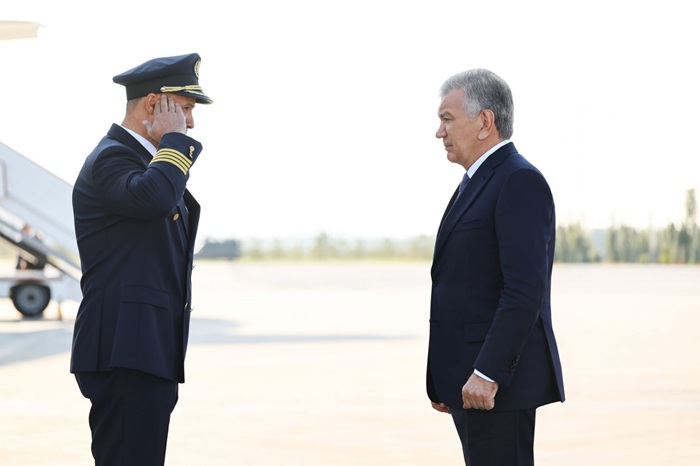
President of Uzbekistan departs for Azerbaijan
President Shavkat Mirziyoyev departed for Baku on October 14 on a working visit at the invitation of President of Azerbaijan Ilham Aliyev.
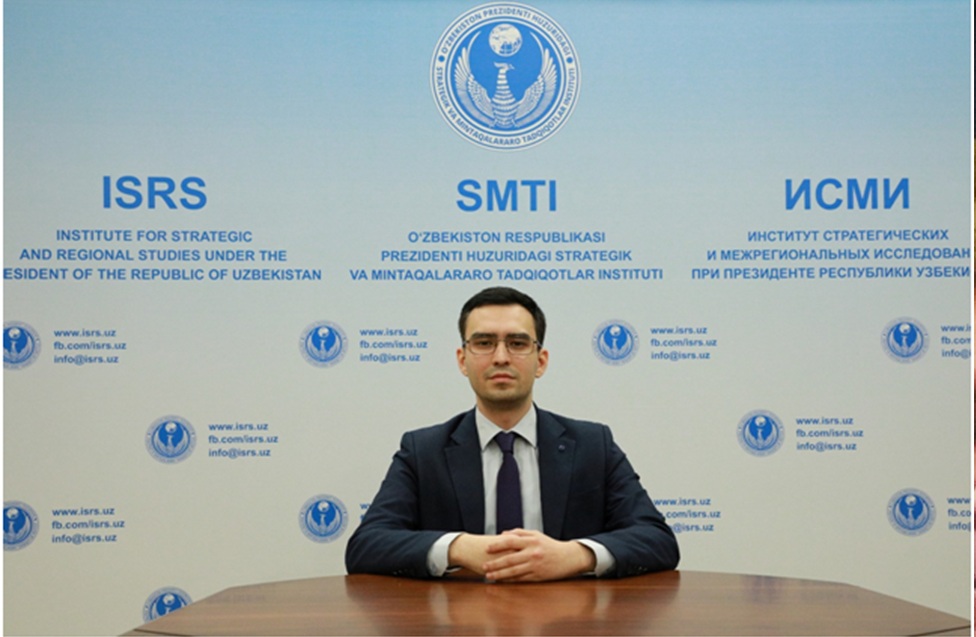
CICA amid a Crisis of Trust: Uzbekistan’s Role in Strengthening Cooperation in Asia
The seventh summit of the Conference on Interaction and Confidence Building Measures in Asia (CICA) will take place in Baku on 15 October.