
Fergana Valley - a space of common values and cultural rapprochement
On October 15-16 of this year, the first meeting of the Fergana Peace Forum entitled “Fergana Valley: joining forces for peace and progress” will be held in the city of Fergana.
The forum is organized by the Institute of Strategic and Interregional Studies (ISRS) under the President of the Republic of Uzbekistan in partnership with colleagues from Kyrgyzstan and Tajikistan, with the support of national and international organizations.
This unique, large-scale event will bring together leading experts, researchers, public figures and representatives of international organizations to discuss the prospects for the development of one of the most densely populated and culturally rich regions of Central Asia - the Fergana Valley.
Experts from authoritative think tanks in the CIS countries, Asia, Europe and America, representatives of academia, the business community, civil society and youth leaders from the countries of the region will gather on one platform. The participation of high-ranking representatives of such international structures as the UN, SCO, CIS, CICA, European Union and OSCE is also expected. Among the invitees are well-known peacekeeping organizations: the German Berghof Foundation, the Finnish Martti Ahtisaari Peace Foundation, the Swiss PeaceNexus, the Stockholm International Peace Research Institute (SIPRI) and others.
In total, more than 300 people will take part in the Forum, including about 150 from Central Asian countries, more than 50 from the CIS countries, Asia, Europe and America.
According to experts, the holding of the forum will confirm the thesis of the President of Uzbekistan Sh.M., voiced at the 80th session of the UN General Assembly. Mirziyoyev on the transformation of Central Asia into a space of peace, good neighborliness and partnership.
Indeed, today, as the Head of Uzbekistan noted, the process of formation of a New Central Asia has begun in the region, the era of closed borders, unresolved disputes and conflicts is a thing of the past, and our region, thanks to its cohesion, stability and growing common identity, occupies an increasingly strong place in the system of international relations as an independent entity.
The choice of venue is also not accidental. The Fergana Valley is a unique region where the vital arteries of three states intersect: Uzbekistan, Kyrgyzstan and Tajikistan, and the atmosphere of trust, dialogue and cooperation established in relations between them is a clear embodiment of the good neighborly policy of the President of Uzbekistan Shavkat Mirziyoyev.
It is important to note that for thousands of years the valley has been a crossroads of trade ways, ideas and peoples, whose population forms a special historical and cultural identity - with a common system of values, a similar way of life, respect for work and deeply rooted traditions of hospitality. Despite the multi-ethnicity, the inhabitants are united by a common memory, linguistic kinship and economic ties.
Here, among the mountains and rivers, a unique cultural code has been formed for centuries, uniting the peoples of the region on the basis of common values.
Thus, reports about the Fergana state of Davan, especially the cities of Aksikent and Mingtepa, which were famous for their fertile lands, strong defenses and valuable horses, are already contained in ancient Chinese chronicles from the end of the 2nd century BC. e., and in the Middle Ages it was one of the leading regions of Transoxiana. The fact that in ancient times the valley was the center of various civilizations is reminiscent of the remains of fortifications from the Bronze Age, the Early Iron Age and medieval monuments.
Han dynasty historiographer Sima Qian noted in his notes about the population of Fergana “People live on the land, plow fields, grow rice and wheat... The population lives in houses, in fortified cities; in this region there are about seventy or more cities of various sizes...»
In the works of medieval Arab geographers, Fergana is referred to as a “country” with many cities and villages, divided into tens or hundreds of settlements. People live in both cities and villages; around are steppes and mountains, pastures and irrigated agriculture.
Indeed, cities like Kokand, Khujand, Osh, Margilan have been centers of crafts, trade and education for centuries. Caravans of the Great Silk Road passed here, the first madrassas were created here, ideas from Persia, China, India and the Arab world came here.
The Fergana Valley is a region historically located at the junction of ancient Greek, Bactrian, Parthian, Chinese and Islamic civilizations. It was this intersection that made the valley a unique point of cultural exchange, which is still felt today: in language, in traditions, in cuisine, in architecture.
Experts are convinced that the peoples of the Fergana Valley represent a single historical and civilizational community, and this is not just a diplomatic formula - it is a reality formed by centuries of political, economic and humanitarian interaction.
This is living evidence of how the coexistence of different cultures is not only possible, but also fruitful. Here not only traditions are preserved, but also new forms of interaction are born - from common holidays to cross-border initiatives. In fact, the region has turned into a kind of laboratory for cultural rapprochement, where the idea of intercivilizational dialogue is put into practice.
With a rich historical and cultural heritage, high population density and enormous economic potential, the region requires special attention in matters of sustainable development, environmental security and cross-border cooperation.
This is where concerted action and open dialogue are especially important - for the sake of peace, mutual trust and progress.
Therefore, the Forum program covers a wide range of current topics - from economics to culture.
- strengthening regional dialogue and trust;
- jointly ensuring stability and sustainable development;
- unlocking the economic and investment potential of the valley;
- development of cultural and humanitarian ties;
- increasing the participation of civil society, youth and the private sector in transformation processes.
Particular attention will be paid to how to turn existing challenges into opportunities, and regional cooperation into a strong platform for peace and prosperity.
Here the Fergana Valley demonstrates maturity. It is the common historical and cultural foundation that allows the countries of the region to build a dialogue not from scratch, but on the basis of already existing trust.
Today, the Fergana Valley is not only a historical and cultural symbol, but also a strategic region for sustainable development and economic cooperation. Joint transport and energy projects, cross-border markets, digital initiatives - all this makes the region an area of active growth.
It can be confidently noted that the Fergana Peace Forum will become not only a platform for discussions, but will turn into a mechanism that will constantly generate ideas, unite efforts and promote projects aimed at the benefit of the entire region.
As the organizers of the forum note, the example of the Fergana Valley can become a model for post-conflict regions of the world, where not only political stabilization, but also deep cultural and humanitarian work. Here, real mechanisms of interaction are created, where a common historical and cultural heritage serves as the foundation for peace and development.
In this context, the fact that among the expected results of the forum is the adoption of a Communiqué calling for the formation of a common space of friendship, good neighborliness and sustainable development of the Fergana Valley.
Past discussions in the framework of the preparation of the Forum have already shown: Fergana the valley is a space where the past inspires, the present unites, and the future is built on the values of peace and cooperation.
In today's world, when conflicts have become commonplace and the global community is looking for new models of sustainable coexistence, the Fergana Peace Forum offers one possible answer: peace begins with trust, and trust begins with open dialogue.
Fergana is not coordinates on a map, but a space where respect becomes the language of communication, friendship is the basis of neighborhood, and diversity of cultures is the strength of unity.
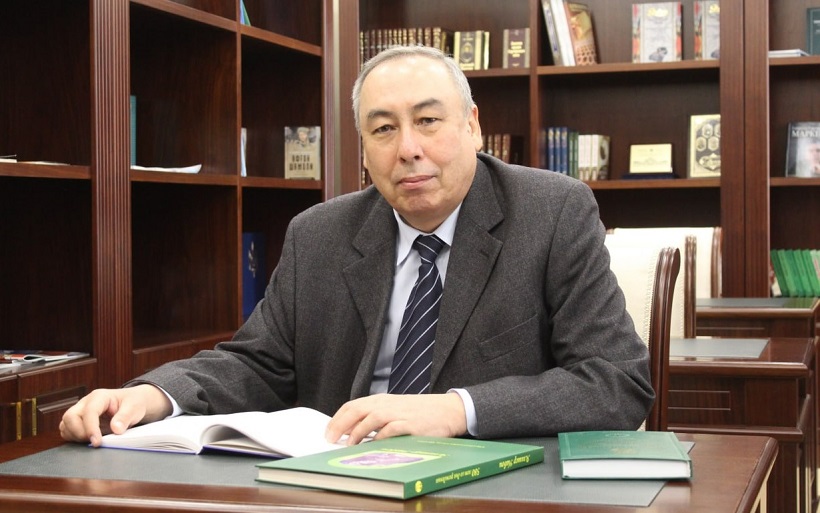
Alisher Sabirov
Doctor of Historical Sciences,
Professor of the National Pedagogical
University of Uzbekistan named after. Nizami,
Associate Professor of Shaanxi
Normal University (PRC)
Related news
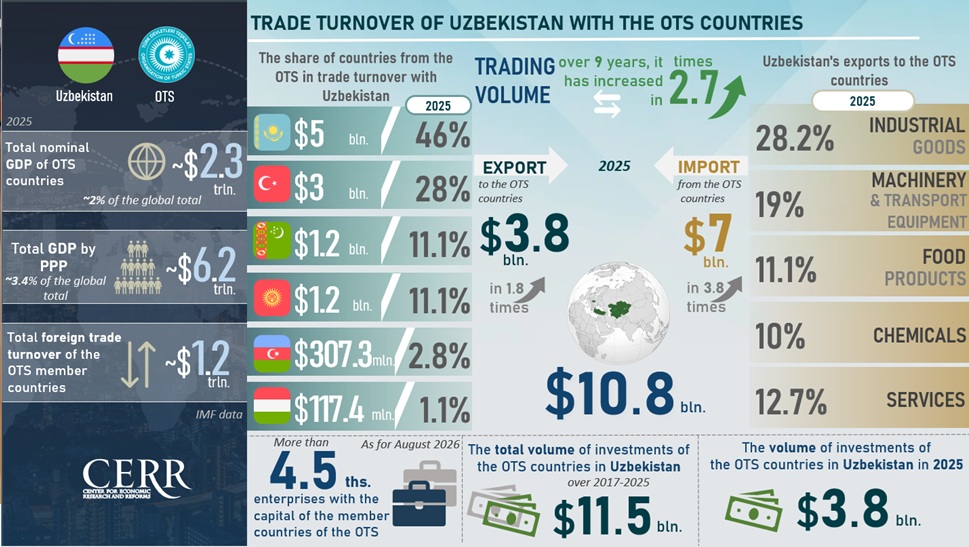
Uzbekistan has moved its economic cooperation with the Turkic states into a practical dimension
Ahead of the 13th Summit of the Organization of Turkic States, scheduled to be held in Ankara, economic cooperation within the OTS is acquiring new substance.
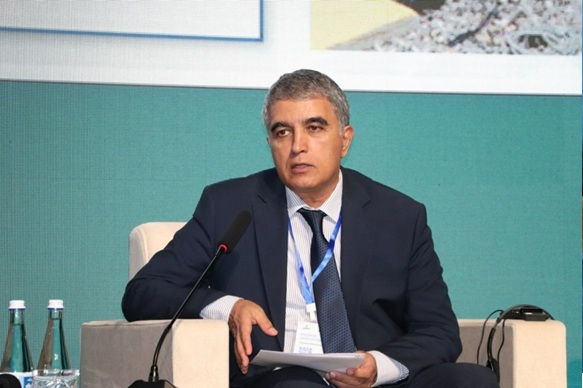
Water security in the turkic world: shared interests and common solutions
Water is a precious blessing that transcends national borders and has long connected peoples and civilizations.

Strengthening Transport Connectivity in Asia through the Development of the Trans-Caspian International Transport Corridor
Shifting international supply chains and expanding trade in Asia are driving demand for sustainable transport routes. For businesses, predictable delivery times, competitive rates, and reliable access to foreign markets are becoming increasingly important.