
Fergana Valley: a shared vision for a strategy for sustainable development and prosperity
The Fergana Valley is the historical heart of Central Asia, where today a new model of regional cooperation based on trust, good neighborliness and sustainable development is being formed. The initiative of the President of Uzbekistan Shavkat Mirziyoyev to hold the Fergana Peace Forum reflects the common desire of the countries of the region to strengthen mutual understanding, create a space of peace, stability and shared prosperity.
INTRODUCTION
The Fergana Valley has historically represented a single space where countries shared resources and the population maintained close communications. For centuries, the valley has been at the crossroads of key trade arteries connecting the West with the East.
The establishment of an atmosphere of good neighborliness in the Fergana Valley reflects positive processes throughout Central Asia. In fact, this is the result of political will, a concentrated expression of the joint efforts of the leaders of all five countries to maintain security and stability in the region.
The holding of the Fergana Peace Forum on October 15-16, 2025 in the city of Fergana allows us to confirm the thesis of the President of Uzbekistan voiced at the 80th session of the UN General Assembly on the transformation of Central Asia into a space of peace, good neighborliness and partnership.
FROM A ZONE OF TENSION TO A SPACE OF TRUST
In the first years of independence, unresolved border issues and the presence of numerous ethno-territorial enclaves served as a reason to consider the region as a conflict formation.
However, today, thanks to political will and joint Thanks to the efforts of the heads of state, the Fergana Valley, previously perceived as a “powder keg”, “Achilles’ heel”, “hot spot”, is turning into a symbol of peace, sustainable development and a space of opportunity.
In recent years, Uzbekistan, Tajikistan and Kyrgyzstan have made significant progress in the field of diplomacy and establishing stable political contacts.
Visits of country leaders, participation in regional forums and organizations such as the SCO and KVGCA contribute to the deepening of political and economic ties. The development of bilateral and multilateral relations in the political sphere has contributed to the creation of strong foundations for regional integration and mutual support.
Moreover, all five Central Asian countries contribute to the sustainable development of the Fergana Valley. Joint water and energy projects are being implemented. In January 2023 Uzbekistan, Kazakhstan and Kyrgyzstan signed a “Road Map” for the implementation of the Kambarata HPP-1 construction project, and in June 2024. - interdepartmental agreement on preparation for the implementation of the project.
The decisive turning point was the new stage of regional diplomacy, which began in 2017 with the beginning of the election of Shavkat Mirziyoyev as President of the Republic of Uzbekistan. Relations with neighboring countries have reached a qualitatively new level. Dialogue based on the principles of openness, respect and equality made it possible to lay the foundation for long-term good neighborliness.
Thanks to the political will of the leaders of three states - Uzbekistan, Kyrgyzstan and Tajikistan - historic agreements were reached in 2025 - the signing of the Treaty on the meeting point of the state borders of the three states and the Khujand Declaration of Eternal Friendship. These documents have become a symbol of a new era of trust and creative partnership. The agreement legally fixed the borders of the three states at a specific point in the Fergana Valley.
Such a breakthrough did not appear suddenly, without preparatory work. In previous months, on March 13, 2025, Kyrgyzstan and Tajikistan signed an important agreement on the demarcation of a common border - the final stage of long negotiations.
President of Kyrgyzstan Sadyr Japarov noted that regional integration continues to actively develop, and strengthening cooperation in all areas will be the key to sustainable development and prosperity throughout Central Asia.
In turn, the President of Tajikistan Emomali Rahmon called the development of relations between the three countries on the principles of good neighborliness, equality and mutual respect one of the priorities of Tajikistan’s foreign policy.
The world community especially points to the irreplaceable role of the President of Uzbekistan Shavkat Mirziyoyev, who spoke the initiator of a new diplomatic line: “borders should not divide, but connect our peoples.”
This approach creates a model of peaceful transformation, when internal, rather than external factors form the architecture of trust, friendship and good neighborliness.
The formation of a space of stability and cooperation in the Fergana Valley became possible without external participation - solely due to the strong political will of the heads of the three states, combined with the desire of the peoples of this region for peaceful coexistence, creating a solid foundation for sustainable peace and prosperity.
FERGHANA VALLEY is an “exemplary model” for building interstate relations in other regions
Fergana Valley is one of the unique oases of Central Asia - a place where the destinies of peoples are intertwined Uzbekistan, Kyrgyzstan and Tajikistan. More than 17 million people live here, which is 20% of all Central Asian residents, whose number is about 83 million.
Today, the valley is gradually turning into a symbol of the new Central Asia - a region where borders become not barriers, but bridges of interaction. The development of transport, trade and humanitarian connectivity between Uzbekistan, Kyrgyzstan and Tajikistan opens the way to the formation of a single space of interaction in the name of common prosperity.
Joint infrastructure and economic projects, restoration of roads and railways, development of border logistics hubs and modernization of checkpoints create conditions for the free movement of people, goods and ideas.
Communications between the Fergana Valley and the outside world are actively developing. Today, it is being integrated into international multimodal transport corridors and is gradually regaining its status as an interregional transit hub connecting East and West.
In this regard, the China-Kyrgyzstan-Uzbekistan railway project is becoming important. If implemented, it will create a multiplier effect for the economies of all countries in the region.
The road will provide access to the ports of the Persian Gulf and the Pacific Ocean, allowing access to new markets, thereby diversifying the economy and creating new jobs.
Visa regimes are simplified and capacity at checkpoints is improved, which will facilitate an increase in mutual travel of citizens.
Uzbekistan maintains a visa-free regime for stay with all countries of Central Asia, with the exception of Turkmenistan. In particular, today there are 17 border checkpoints between Uzbekistan and Tajikistan, and 25 with Kyrgyzstan. between Uzbekistan and Kyrgyzstan there were only 13, and all worked with restrictions. For example, currently up to 20 thousand people pass through the Dustlik checkpoint alone on the Uzbek-Kyrgyz border every day - 100 times more than in 2016. At the same time, transport throughput has increased 10 times and reaches 700 units per day.
In 2023 The border crossing points “Mingtepa” and “Khanabad” were opened, in 2024 – “Uchkurgan” and “Karasu”. These points have been closed since 2009-2010.
Today, citizens of Uzbekistan and Kazakhstan have the opportunity to make mutual trips for a period of 30 days without registration. A visa-free regime has been established between Uzbekistan and Kyrgyzstan for a period of up to 60 days, and from September 1, 2023. It has become possible to use ID cards (instead of foreign passports) for mutual travel of citizens of the two states.
The time for passing goods and people has been reduced to an unprecedented 8 minutes. In turn, citizens of Tajikistan and Uzbekistan can stay in each other’s territory for up to 30 days without obtaining a visa. This, in turn, helps to intensify interaction and improve mutual understanding between the peoples of the Fergana Valley.
In general, a common space is being formed in the Fergana Valley, as it has been throughout history. Restoring the interconnectedness of the valley helps ensure stability and sustainable development of the entire region.
The great attention of the international community to these processes confirms that Central Asia is becoming an important center for the formation of a culture of peace. The initiatives put forward by Uzbekistan have received the support of the UN, OSCE, EU and other international partners, which strengthens the legitimacy and sustainability of regional efforts.
The Fergana Peace Forum occupies a special place in this process - not just a diplomatic meeting, but a platform for developing a new philosophy of regional cooperation. This forum brings together political leaders, experts and public figures, offering open dialogue on building peace, trust and sustainable development in Central Asia.
The event will allow the countries of the region to independently form their own architecture of stability and sustainable development, based on mutual respect and the desire for a better future for new generations.
CONCLUSION
The Fergana Valley is gradually turning into a space of peace and harmony, where peoples find a common language and jointly strengthen sustainability region.
The establishment of an atmosphere of friendship and good neighborliness in the Fergana Valley shows that today, in conditions of global turbulence, ensuring stability in the region is a feasible task.
This process requires patience, wisdom and a willingness to make reasonable compromises. Uzbekistan, Kyrgyzstan and Tajikistan have shown the presence of these qualities and the ability, despite difficult challenges, to unite for common goals, such as strengthening security and sustainable development.
In turn, the Fergana Peace Forum is intended to become a permanent platform aimed at strengthening dialogue and trust, ensuring sustainable development of the Fergana Valley, unlocking economic potential and strengthening cultural and humanitarian ties. The holding of this meeting reflects the unity of the states of the region, which have firmly decided to jointly shape a common future.
Mukhsinova Diloram and Alimdzhanov Bekhzod
Chief research fellows of the Center
foreign policy research
(Uzbekistan)
Related news
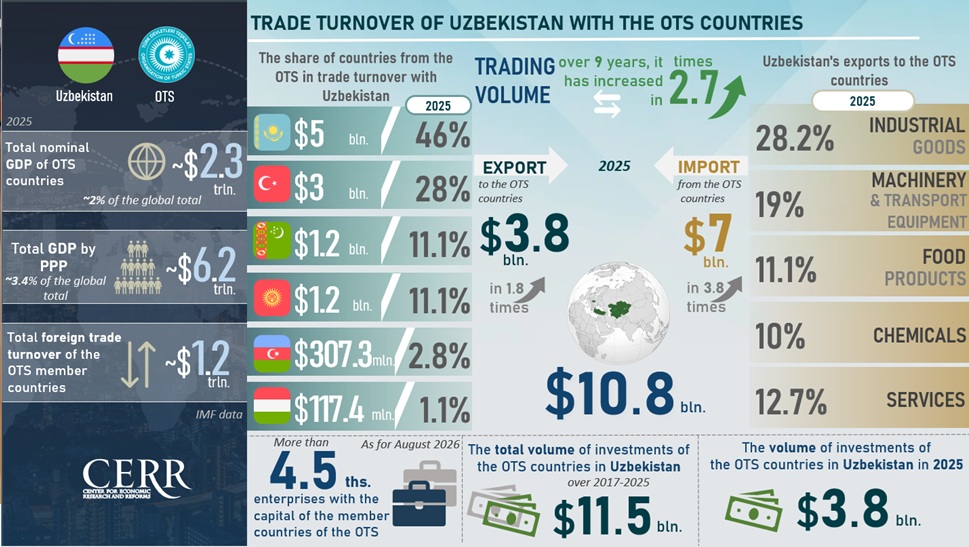
Uzbekistan has moved its economic cooperation with the Turkic states into a practical dimension
Ahead of the 13th Summit of the Organization of Turkic States, scheduled to be held in Ankara, economic cooperation within the OTS is acquiring new substance.
Water security in the turkic world: shared interests and common solutions
Water is a precious blessing that transcends national borders and has long connected peoples and civilizations.

Strengthening Transport Connectivity in Asia through the Development of the Trans-Caspian International Transport Corridor
Shifting international supply chains and expanding trade in Asia are driving demand for sustainable transport routes. For businesses, predictable delivery times, competitive rates, and reliable access to foreign markets are becoming increasingly important.