
Energy transformation of Uzbekistan: gradual transition to market mechanisms
Since 2017, Uzbekistan has been implementing large-scale reforms in the energy sector, aimed at increasing efficiency, modernizing infrastructure and transitioning to market mechanisms. During the period from 2017 to 2024, key legislative and institutional decisions were adopted, including 8 laws and over 90 acts of the President of the Republic of Uzbekistan and the Cabinet of Ministers, which provided the regulatory framework for a deep transformation of the industry.
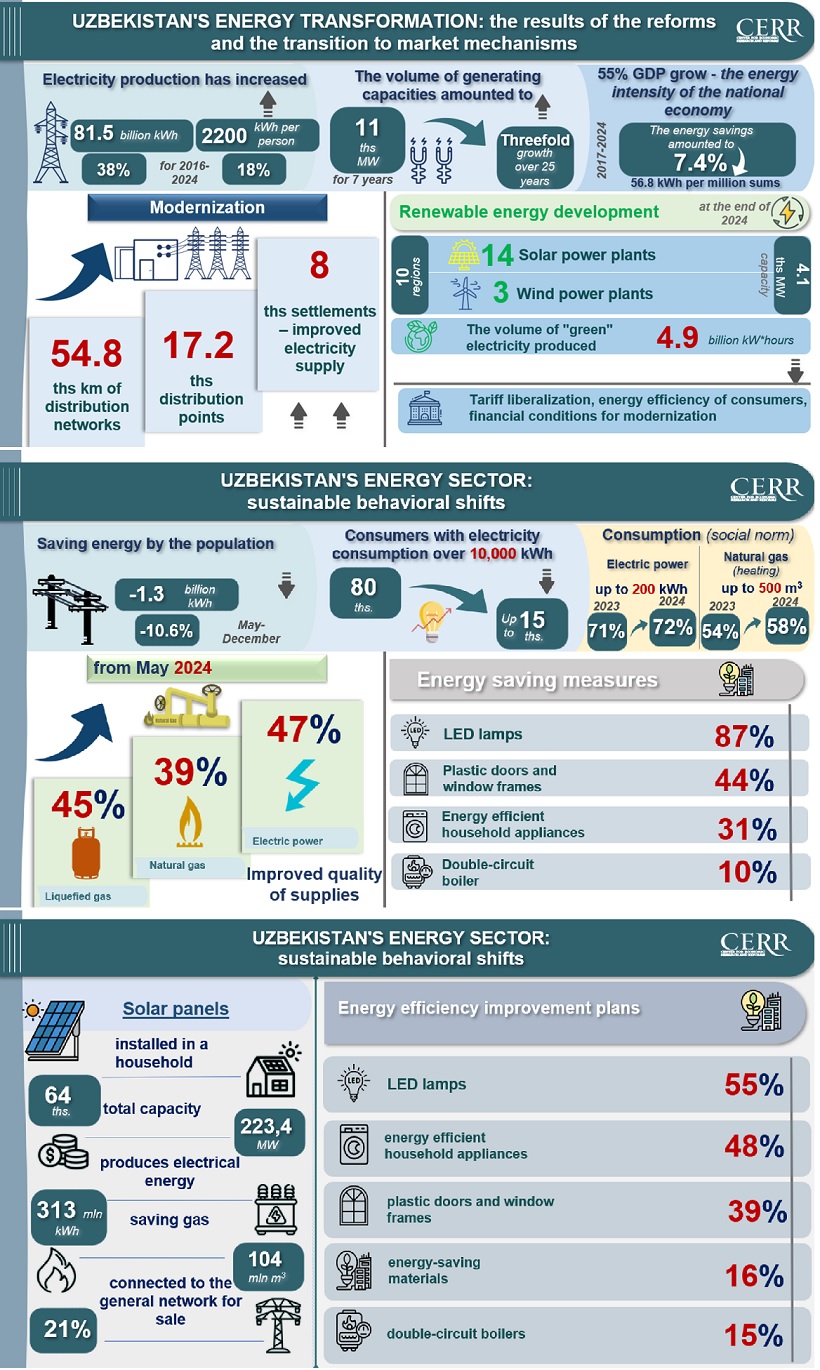
Electricity production in the country increased by 38%, from 59 billion kWh in 2016 to 81.5 billion kWh in 2024. At the same time, the per capita production level increased by 18%, reaching 2200 kWh. Over seven years, 11 thousand MW of new generating capacity was put into operation, which is three times the volume in the previous 25 years.
Despite the rapid growth of the economy, Uzbekistan manages to consume less energy for each product or service produced. From 2017 to 2024, the country's GDP increased by 55%, while energy costs per unit of output decreased by 7.4%. The economy began to operate with lower energy costs. Industry, services and agriculture have moved towards a more rational use of resources.
This dynamic means that the economy has begun to operate more efficiently, producing more with less energy per som of added value, with a current consumption level of 56.8 kWh per million soum.
In addition, more than 54.8 thousand km have been modernized distribution networks and 17.2 thousand transformer points. As a result, improved electricity supply was ensured in more than 8 thousand settlements throughout the country. For comparison, from 1991 to 2016, only 9.3 thousand km of power lines and 4.8 thousand transformers were renewed.
Particular attention is paid to the development of renewable energy. By the end of 2024, 14 solar and 3 wind power plants with a total installed capacity of 4.1 thousand MW were put into operation in 10 regions of Uzbekistan. In 2024, the volume of produced “green” electricity amounted to 4.9 billion kWh.
Improving the efficiency and rational use of energy resources through liberalization of tariffs
The continuation of reforms in the energy sector was the liberalization of tariffs, aimed at creating sustainable market mechanisms and attracting investments from taking into account growing demand. To assess its impact, the Center for Economic Research and Reforms conducted a study analyzing the behavior of households under the new tariff policy, based on social consumption norm, introduced in May 2024.
3516 people took part in the study households throughout the country. Data on the consumption of 3.5 million gas subscribers and 8 million electricity subscribers were also analyzed, which made it possible to understand how energy consumption changed and how the population reacted to changes in tariffs.
The analysis results showedthat from May to December 2024, electricity consumption decreased by 10.6% compared to with the same period in 2023, which is equivalent to savings of 1.3 billion kWh.
The number of households that previously consumed more than 10,000 kilowatt-hours per month decreased especially noticeably. In 2023 there were almost 80 thousand, and in 2024 this number dropped to 15 thousand.
It is interesting that the majority of citizens continued to use energy within the usual norms. The share of subscribers consuming up to 200 kilowatt-hours per month remained stable at 71% in 2023 and 72% in 2024.
Similar trends are observed in natural gas consumption, where in 2024 58% of subscribers used up to 500 cubic meters, while in 2023 - 54%. Thus, the tariff increase did not lead to sharp changes in the volume of basic consumption.
The most significant decrease was observed in regions with relatively high initial consumption, such as Samarkand, Tashkent, Andijan and Namangan regions. The number of households with a high level of consumption (over 10,000 kWh per month)has significantly decreased, indicating a transition to more economical use of energy resources.
In parallel with this, there is an improvement in the quality of energy supply. According to the survey results, almost half of the respondents noted positive changes in the supply of electricity, as well as the availability of natural and liquefied gas.
47% of households noted an improvement in the supply of electricity, especially in regions such as Surkhandarya (78%), Syrdarya (70%) and Namangan (67%) regions.
The supply of natural gas gas improved for 39% of respondents, with the highest rates recorded in Khorezm and Surkhandarya regions (68% each), as well as in the Jizzakh region (60%).
The supply of liquefied gas improved for 45% of households, in particular in Syrdarya (73%), Surkhandarya (62%) and Namangan (59%) regions. Thus, the results indicate increased access to basic energy services as a result of ongoing reforms.
One of the key changes has been the widespread adoption of energy efficient solutions at the household level. Over 90% of respondents reported implementing at least one measure to reduce energy costs.
The most common practice was installing LED lighting fixtures. 87% of households have switched to LED lighting. In some regions, such as Karakalpakstan, Khorezm, Navoi and Tashkent regions, such families have increased to more than 90%.
44% of households improved the thermal insulation of windows and doorsby installing plastic structures, especially active in the Kashkadarya region (84%), Bukhara (69%) and Khorezm (54%).
31% purchased energy-efficient household appliances, with the largest share of such solutions observed in Jizzakh (60%), Navoi (59%) and the Republic of Karakalpakstan (54%).
Additionally, there is a growing interest in the use of renewable energy sources.
Already 64 thousand households across the country have installed solar panels with a total capacity of 223.4 MW. Annual production is about 313 million kWh, which is equivalent to saving 104 million m3 of natural gas.
More than half of the owner families expressed satisfaction with the results and interest in expanding generation. The analysis shows that potential demand for solar panels among the population is about 1.9 million households, which opens up the prospect of creating a domestic market worth over $2.3 billion.
At the same time, a high share of consumption remains through less efficient heating sources, including outdated gas boilers and furnaces in solid fuel fuels, which emphasizes the need to modernize housing infrastructure and provide incentives for the transition to modern technologies.
At the same time, investment potential is being formed in the field of improving the energy efficiency of buildings. It is estimated that savings of over $60 million per year can be achieved in the nation's multi-family housing stock by insulating façades, upgrading heating systems, and replacing outdated windows and doors.
Increasing energy efficiency: economic benefits and environmental impact
The World Bank estimates that similar potential exists in public service buildings, including educational and educational institutions. healthcare, where targeted investments in thermal modernization can provide energy savings of 20-50% and create opportunities to reduce consumption by up to 7.1 billion kWh per year.
In addition to the economic benefits, these measures contribute to a significant reduction in greenhouse gas emissions of up to 780 thousand tons of CO₂ annually. The country already has a market for trading carbon units, and we successfully sell excess quotas to other countries. The implementation of these measures will allow for an additional increase in sales volumes, which can generate income of up to $50 million per year.
Thus, the ongoing reforms ensure a gradual transition to a sustainable and efficient energy system based on modernization, energy efficiency and market principles.
Public Relations Service CEIR
Related news
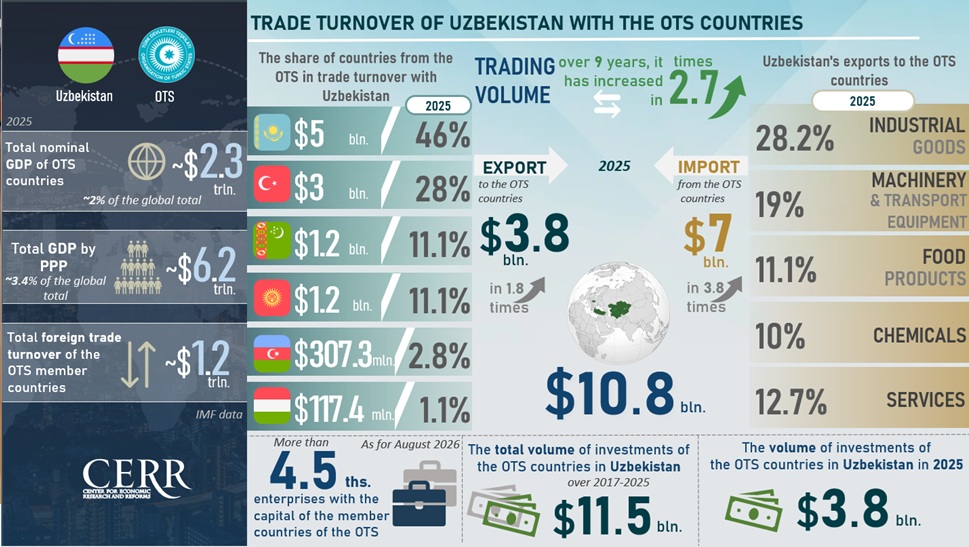
Uzbekistan has moved its economic cooperation with the Turkic states into a practical dimension
Ahead of the 13th Summit of the Organization of Turkic States, scheduled to be held in Ankara, economic cooperation within the OTS is acquiring new substance.
Water security in the turkic world: shared interests and common solutions
Water is a precious blessing that transcends national borders and has long connected peoples and civilizations.

Strengthening Transport Connectivity in Asia through the Development of the Trans-Caspian International Transport Corridor
Shifting international supply chains and expanding trade in Asia are driving demand for sustainable transport routes. For businesses, predictable delivery times, competitive rates, and reliable access to foreign markets are becoming increasingly important.