
Economic cooperation between the SCO countries
Analysis of the effectiveness of economic programs adopted within the SCO
Economic potential of the SCO
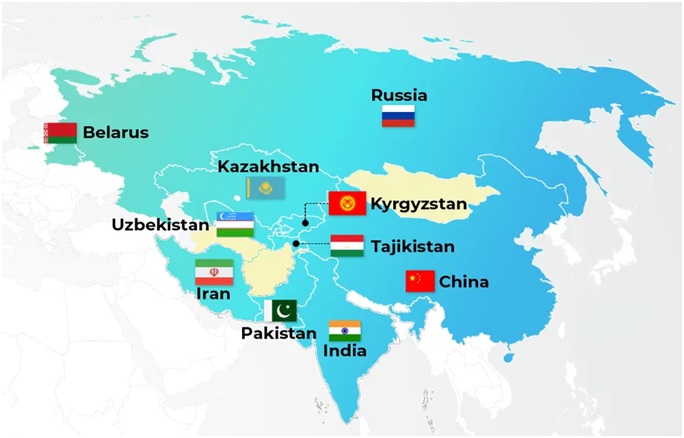
The territory of the SCO countries collectively makes up about 27% of the world's landmass, and on the continent of Eurasia more than 60%. The total population of the SCO countries is more than 428% of the world's population(3.4 billion out of 8 billion population).
SCO countries form 23.6% of world nominal GDP and 33.8% of world GDP at purchasing power parity (PPP). In particular, in the world ranking, China and India take 2nd and 7th place in terms of nominal GDP($18,75 trillion and $3,91 trillion, respectively). 2024 on average 5.4% (world average 3.3%).
At the same time, the SCO countries have different sizes of economies, their goods have different competitive advantages, and markets have different degrees of openness; there is an imbalance in mutual trade in favor of large economies and primarily China, Russia and India.
In In 2015, China, and then in 2017, Kazakhstan, in order to increase the volume of mutual trade, proposed the gradual creation of an SCO free trade area. However, given the competitive advantages of Chinese goods, the implementation of this proposal could further increase the imbalance in foreign trade for many SCO countries.
In recent years, the volume of domestic trade between the SCO countries has increased significantly. For example, in 2021, domestic exports of the SCO countries amounted to $463 billion, or 10.4% of the total exports of the SCO countries, and in 2024, already $725 billion, or 15.3%.
The growth of internal trade of the SCO countries in recent years is mainly related to Russia's reorientation of its trade from the West to the East, including to China and India.
For example, since 2021, Russia's exports to China have increased 1.7 times from $78 billion to $129 billion, and China's to Russia also increased 1.7 times from $68 billion to $116 billion, Russian exports to India increased 7.4 times from $8.7 billion to $64.2 billion, and India to Russia from $3.3 billion to $4.9 billion. At the same time, the share of SCO countries in Russia’s total exports increased from 26.7% (in 2021) to 59.6% (in 2024).
In China's total exports, the share of exports with SCO countries also increased from 6.8% (in 2021) to 9.4% (in 2024).
The share of exports with SCO countries in total exports is also high Belarus (58.1%), Tajikistan (52.3%), Kyrgyzstan (50.1%), Kazakhstan (37.1%), Uzbekistan (33.4%) and Iran (33%).
Exports of India and Pakistan less dependent on the markets of the SCO countries, the share of exports to the SCO countries from India is 5.3%, Pakistan - 8.8%.
At the same time, in the total volume of exports between the SCO countries (internal trade), China accounts for $336.1 billion. (46.2%), Russia - $258.7 billion. (35.7%), Iran - $34.5 billion. (4.8%), Kazakhstan - $30.3 billion. (4.2%), Belarus - $28.6 billion. (3.9%), India - $23.4 billion. (3.2%), Uzbekistan - $9.0 billion. (1.2%), Pakistan - $2.8 billion. (0.4%), Kyrgyzstan - $1.9 billion (0.3%) and Tajikistan - $1.0 billion (0.1%).
Uzbekistan's trade with the SCO countries
SCO countries, in particular Russia, China and Central Asia are among the main trade and economic partners of Uzbekistan.
For the period 2017-2024. Uzbekistan’s trade turnover with the SCO countries increased 2.5 times from $12.9 billion to $32.5 billion, exports by 1.6 times from $5.8 billion to $9.0 billion, imports by 3.3 times from $7.1 billion to $23.5 billion.
At the same time, the share of trade turnover with the SCO countries in the country's total foreign trade turnover increased to 49.4%, in total exports it decreased to 33.4%, in total imports it increased to 60.4%.
In 2024, the SCO countries accounted for 33.4% (9.0 billion) of the total export volume, excluding gold ($7.48 billion in 2024), the share of the SCO countries in the total export volume of Uzbekistan will be 46.3%.
In 2024, compared to 2023, trade turnover with the SCO countries increased by 0.1% to $32.5 billion, exports decreased by 3.5% to $9.0 billion, imports increased by 1.6% to $23.5 billion.
The largest share in Uzbekistan’s foreign trade with the SCO countries in 2024 was occupied by China - $12.5 billion. (38.4%), Russia - $11.6 billion. (35.7%), Kazakhstan - $4.3 billion (13.1%),then India - $980.4 million (3.0%), Kyrgyzstan - $846.4 million (2.6%), Belarus - $714 million (2.2%), Tajikistan - $702.7 million (2.2%), Iran - $496.6 million (1.5%)and Pakistan – $404.5 million (1.2%).
It should be noted that the markets of the SCO countries are the main consumers of finished export products of Uzbekistan. For example, the SCO countries are supplied with the bulk of all exported by Uzbekistanfruits and vegetables and other food products, electrical goods, as well as products from the textile and automotive industries.
At the same time, Uzbekistan imports from the SCO member countries products and products that are important for economic development raw materialswhich are necessary for the operation of production enterprises, as well as to meet consumer demand in the domestic market. In particular, the bulk of metal products, wood and petroleum products come from the SCO countries. In addition, more than 50% of imported machinery and equipment,including components for the production of finished products, are imported from the SCO countries, mainly from China.
The SCO countries play a key role in ensuring the food security of Uzbekistan –about 70% of total food imports come from the SCO countries, in particular, the bulk of vegetable oil and grain products are supplied from Russia and Kazakhstan.
Uzbekistan is interested in the practical implementation of all agreements and agreements between the SCO countries to achieve the maximum economic effect from their participation in this organization.
SCO program documents.
During the period of SCO activity, a number of program documents in the economic sphere were adopted within the organization, which usually only list the directions, goals and objectives, as well as intentions for the further expansion of economic cooperation in various fields.
This is largely due to the fact that, in accordance with the provisions of the documents signed during the creation of the organization, the SCO is neither a military bloc, nor an economic or customs union, nor a free trade zone, but is an international regional organization in which the highest (CYS summits) and working (Secretariat) bodies have been created.
In order to develop trade and economic cooperation between the SCO member states and improve the investment climate, the “Program of Multilateral Trade and Economic Cooperation of the SCO Member States” was approved in September 2003, and in 2004 the “Action Plan for its Implementation”, in 2005 the “Mechanism for Implementing the Action Plan for the Implementation of the Program”. In 2008, the heads of government of the SCO member states approved an updated version of the “Action Plan for the Implementation of the Program of Multilateral Trade and Economic Cooperation of the SCO Member States.”
The mechanism for implementing the Action Plan provided for the adoption of mutually agreed upon practical measures and the implementation of joint projects by concluding multilateral intergovernmental and interdepartmental agreements, and joint projects will be implemented on the basis of decisions of the SCO bodies on the approval of joint projects.
In 2005 in Moscow, the heads of government SCO member countries signed the Agreement “On interbank cooperation (unification) within the SCO" with the aim of creating a mechanism for financing and banking services for investment projects supported by the governments of the SCO member states.
In 2006, the SCO Business Council was established in Shanghai - a non-governmental structure uniting the most authoritative representatives of the business community of the SCO member states(mainly through the Chamber of Commerce and Industry)with the aim of expanding economic cooperation within the organization, as well as its permanent secretariat, which is located in Moscow.
At the same time, the tasks of the SCO Business Council include, for example, promptly informing the business circles of the member countries about business opportunities and legal and regulatory features of doing business in partner countries, which should help attract private capital and direct investment from large companies in the processes of economic integration of the countries SCO.
In 2014, the “Agreement between the governments of the SCO member states on creating favorable conditions for international road transport” was signed, which, in particular, provides for the provision of certain benefits for carriers of the state of one Party on the territory of the states of the other Parties.
In 2015, the SCO Development Strategy until 2025 was approved; in the section “trade and economic cooperation” the Strategy lists a number of directions and areas in which it is planned to develop cooperation (extract from the Strategy in the appendix).
In addition, the Strategy It was noted that SCO members will continue to work on the creation of the SCO Development Bank and the SCO (Special Account) Development Fund, and will also support the active participation of the SCO Business Council and the SCO Interbank Association in the selection and implementation of trade and economic cooperation projects in the SCO space, primarily in innovative areas of the economy.
In November 2019, a new “Multilateral Program” was adopted trade and economic cooperation of the SCO member states", which also contains only a list of priority areas and tasks of cooperation in particular, in trade and investment, banking and financial, transport and logistics sectors, industry, agriculture, energy, customs, digitalization, ICT and innovation, in the field of spatial development, tourism and others.
The implementation of this Program will be carried out relevant ministries, departments, Special Working Groups and economic entities of the SCO member states, with the assistance of the SCO Secretariat, the SCO Business Council and the SCO Interbank Association through the implementation of the relevant Action Plan.
In 2022, the ministries responsible for foreign economic activity approved the “Joint Action Plan for the development of intraregional trade within the SCO in 2023-2025”, which mainly provides for discussion and exchange of experience on trade facilitation mechanisms within the framework of existing working groups, exchange of information on a mutual basis on legislation in the field of technical regulation, sanitary and phytosanitary measures, the list of goods subject to mandatory certification and its updates and other information.
In September 2022, the following were adopted:
- “Program for stimulating industrial cooperation between the business communities of the SCO member states”, which provides for the creation by the SCO countries of joint cooperation projects and favorable conditions for cooperation between business entities of the SCO countries in organizing value chains, including in interaction with the Business Council SCO, etc.
- “Program of cooperation between the authorized bodies of the SCO member states in the field of use of renewable energy sources” (VEI). The implementation of the Program will be ensured through the implementation of action plans for cooperation of the SCO countries in the field of use of renewable energy sources, prepared by the relevant relevant ministries and departments, and relevant international agreements and other documents may also be concluded.
In October 2024, the “Concept for the development of the New Economic Dialogue between the SCO countries” was approved, which provides for the intensification of interaction between the SCO countries in the trade and economic sphere by increasing the efficiency of existing cooperation mechanisms within the SCO, as well as creating additional platforms for the development of mutually beneficial and sustainable ties between the business circles of the SCO countries in areas of mutual interest.
Within the SCO a number of other program documents on the development of economic cooperation in various fields have also been adopted, which have a similar structure.
Conclusions.
Most of the economic programs adopted within the SCO mainly indicate the directions and areas of cooperation in which interested ministries, departments and economic entities of the SCO countries can establish practical interactionincluding signing interdepartmental cooperation agreements and implementing joint projects.
At the same time, the economic structures created under the SCO (Business Council, Interbank Association, economic forums, including regional ones) do not play a leading role in the economic processes occurring between the SCO countries.
Until now, the SCO Development Bank has not been created, which could finance joint projects of the countries SCO.
Cooperation in the economic sphere between the SCO countries mainly develops at the bilateral level or within the framework of other organizations (CIS, EAEU), which simultaneously include individual SCO countries, and at the multilateral level within the SCO, large joint economic projects are practically not implemented.
In addition, economic cooperation between private economic entities of the SCO member countries is carried out mainly through already established bilateral contacts and is usually not associated with the participation of their countries in the SCO.
In trade, economic and investment cooperation within the SCO, it is important for Uzbekistan to not allow one large SCO economy to dominate the country's economy.
In investment cooperation, it is advisable to attract investments and loans primarily for the modernization and creation of industrial production, the profits of which will guarantee the repayment of loans, and foreign investments in key and strategic sectors of the economy should ultimately not lead to a complete transfer of ownership to the foreign partner (or be controlled by a foreign party).
Yuri Kutbitdinov
Chief Researcher, CEIR
* * * * * * *
SCO Development Strategy until 2025.
Trade and economic cooperation includes:
- further expansion of mutually beneficial trade and economic interaction in the SCO space, including by creating a favorable investment and business climate, support for business initiatives, implementation of projects in priority areas and infrastructure development;
- establishing cooperation in the development of production capacities on the basis of mutual benefit, helping to minimize the negative consequences of globalization and crisis phenomena in international countries for national economies economic processes;
- implementation of specific economic and investment projects within the SCO, including the training of specialized specialists;
- development of mutually beneficial cooperation in the innovation sphere, including small and medium-sized businesses, implementation of cross-border and interregional projects, creation of joint production;
- realization of transit potential SCO, the formation of regional transport and transit corridors;
- interaction in the field of modernization of infrastructure and logistics, including by expanding the network of international logistics centers in the SCO space and the formation of a network of industrial clusters along transport arteries;
- development of mutually beneficial diverse cooperation in the energy sector, including in the field of the use of renewable and alternative energy sources;
- development of joint high-tech projects for the production and processing of agricultural products, introduction of innovative technologies in the field of agriculture, including the food sector.
Related news
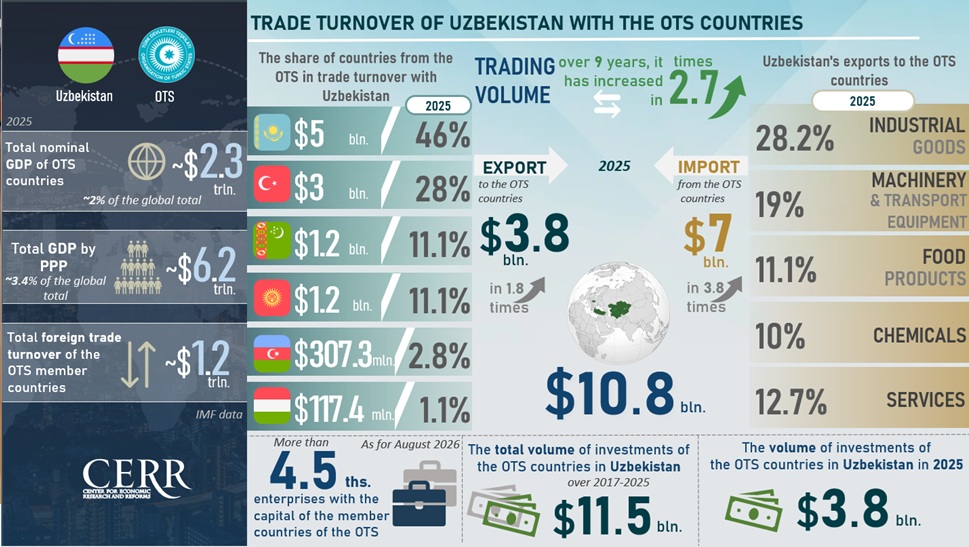
Uzbekistan has moved its economic cooperation with the Turkic states into a practical dimension
Ahead of the 13th Summit of the Organization of Turkic States, scheduled to be held in Ankara, economic cooperation within the OTS is acquiring new substance.
Water security in the turkic world: shared interests and common solutions
Water is a precious blessing that transcends national borders and has long connected peoples and civilizations.

Strengthening Transport Connectivity in Asia through the Development of the Trans-Caspian International Transport Corridor
Shifting international supply chains and expanding trade in Asia are driving demand for sustainable transport routes. For businesses, predictable delivery times, competitive rates, and reliable access to foreign markets are becoming increasingly important.