
Central and South Asia: steps towards restoring forgotten connections

As you know, from May 19 to 21, 2025, the first meeting of the Termez Dialogue on interaction between Central and South Asia will be held in Termez, dedicated to the topic - “Building a common space of peace, friendship and prosperity.” At this meeting, along with representatives of the foreign policy departments of the countries of Central and South Asia, which are becoming the center of attention of world politics, the participation of representatives of specialized UN organizations, international and regional organizations such as the CIS, SCO, CICA, as well as leading specialists and experts in relevant industries is expected.
Central and South Asia have been connected since ancient times by reliable trade routes and served as a bridge for the countries of the Middle East, Europe and China. The peoples of this region have a historical and civilizational community, which in the past were repeatedly within the framework of common state associations, as well as a single political, economic and humanitarian space. Over the course of many centuries, the relationship between the two regions was strengthened by numerous migration flows, intensive trade exchanges, the rapid spread of scientific ideas and cultural mutual influence.
As a result of the spread of Zoroastrianism, Hinduism, Buddhism and Islam, unique ethnocultural associations were formed in these regions, which left a deep mark on the history of mankind.
The entry of the peoples of this region into the composition of such countries as the Bactrian and Kushan kingdoms, the Turkic Khanate, Khorasan and Movarounnahr, the states of the Ghaznavids, Timurids, and Baburids had a huge impact on their historical, cultural and political development. Common customs, traditions, and lifestyles of the population were formed; holidays and spiritual values were created in Persian, Turkish and Arabic. Such medieval cities as Bukhara, Samarkand, Termez, Balkh, Herat, Ghazna, Agra, and Delhi were common centers of science.
The mutual competition of the colonial states had a negative impact on the traditional ties, trade and cultural exchange of the peoples of Central and South Asia. Trade and economic relations in South Asia have changed, and local supply chains and major industrial and economic sectors have become dependent on extra-regional supplies. This event weakened the traditional cultural ties between South Asia and Central Asia.
Today, joint resolution of existing problems that threaten peace and stability in the region is one of the important factors in the social, cultural and economic development of countries. Therefore, the renewal of their close historical ties is becoming increasingly urgent. Taking into account the above, the Termez Dialogue on the Interconnection between Central and South Asia is being organized.
The location chosen for the dialogue is related to the geostrategic location of this city, located at the crossroads of Central and South Asia, or at the intersection of interregional interconnection roads. Since ancient times, Termez has been a center of trade, economy, crafts, a connecting link between the vast regions of Central and South Asia. Therefore, from a geopolitical point of view, the city can be considered a “natural bridge” connecting Central and South Asia, the most suitable place for bringing together the peoples of the region through its historical location and cultural heritage.
Currently, the countries of Central and South Asia are a territory of global importance, with a population of more than 2 billion people. and great educational potential. The region is experiencing high demographic growth, the majority of the population consists of young people, and there are huge opportunities for realizing intellectual potential. While the population of South Asian countries is about 2 billion people, the number of people living in Central Asia is about 82 million people and in the states of the Central Asian region the population is growing year by year. Countries experience “disparities in literacy rates.” For example, among the leading countries of Central Asia, the average adult literacy is 99 percent, in South Asia - 74 percent.
One of the pressing problems is the uneven quality of education, the lack of sufficient coverage of preschool and higher education, especially among girls and residents from remote areas. In South Asia, youth unemployment remains high, with rates exceeding 40 percent in some countries. At the same time, the female employment rate is one of the lowest in the world. In addition, the infrastructure of educational systems is insufficiently developed, the lack of specialists and the qualifications of teachers also create a number of problems.
In this context, cooperation in the field of science and education becomes relevant. Scientific cooperation in the context of digitalization and geopolitical instability will allow maintaining dialogue between academic circles. At the same time, limited academic mobility and weak coordination between scientific communities significantly hamper the development of the potential of states in the field of science, innovation and technology.
In this regard, it is necessary to encourage joint research and innovation work, the organization of scientific and educational internships, experience exchange programs, the development of startups, and competitions.
The adoption of a joint program of academic and research exchanges under under the auspices of UNESCO. It is also necessary to launch an online platform between universities and research structures of the countries of Central and South Asia.
This will contribute to the creation of a sustainable regional network of science diplomacy, the formation of a common agenda in the field of education and technology, as well as the emergence of a single scientific space.
The above steps will serve as a powerful tool for the development of scientific diplomacy, which will allow for the establishment of interaction between the countries of the two regions.
From this point of view, the integration of intellectual resources in Central and South Asia, strengthening cooperation in the field of education and the development of cooperation platforms to improve the quality of education are important for the future of the region. The transformation of demographic potential into human capital is the main condition for sustainable development, economic growth and a worthy place in global competition for both regions. In this regard, the most relevant is the development of education as one of the priority areas of regional cooperation, the development of partnerships for the exchange of experience and training in different countries.
The countries of the region, in particular India and other countries of South Asia, have been occupying an increasingly prominent place in the world community in the field of science, technology and innovation in recent decades. In India, areas such as information technology, aeronautics, drug production and artificial intelligence are developing dynamically. For example, in 2014, the Indian Space Research Organization (ISRO) made history as the first Asian country to launch an artificial satellite into Mars orbit. In 2023, the Chandrayaan-3 project successfully landed on the lunar surface. These results demonstrate the country's independent and innovative capabilities in the scientific field.
In the field of information technology, India has become one of the world's largest IT outsourcing centers. Cities like Bangalore, Hyderabad, Pune and Chennai have become major hubs for Google, Microsoft, Amazon, IBM, Oracle and many other multinational corporations. Every year, the country trains millions of specialists in the technical and technological fields. Among higher educational institutions in India, there are such reputable research centers as the Indian Institutes of Technology (IITs) and Indian Institutes of Science (IISc), which also occupy high positions in world rankings. It should be noted that scientific research in the fields of artificial intelligence, bioengineering, quantum computing and cybersecurity is widespread in the country.
Pakistan has also seen progress in the field of science, especially in nuclear energy and military technology. Centers such as COMSATS University and Pakistan Institute of Engineering and Applied Sciences (PIEAS) play an important role in the development of science in the country. In particular, in order to strengthen international cooperation in the field of IT and cybersecurity, government programs are being adopted.
In Bangladesh, along with the textile and light industry, information technology is on the path of development. In the country, based on the “Digital Bangladesh” strategy, e-government, digital and distance education services have been widely introduced. More than 120 IT parks were created in Bangladesh in 2021, demonstrating the country's commitment to digitalization of the economy.
Afghanistan's scientific and technological potential is still limited, and problems related to political stability are hampering its development. Despite this, some universities and educational institutions in the country, in particular Kabul University, are involved in scientific projects thanks to the assistance of various international educational organizations.
In this regard, the development of a joint digital connectivity strategy between Central and South Asia is important. The adoption of this document will create great opportunities for stimulating trade and investment, improving access to education and healthcare, strengthening regional cooperation and increasing competitiveness on the world stage.
Coordinating the efforts of the countries of Central and South Asia to widely implement the digital economy will help improve digitalization procedures in all spheres of life. Moreover, this will advance the implementation of the SDG initiative to ensure safe public access to the Internet and open up greater opportunities for education and health services.
In general, deepening digital connectivity between Central and South Asia will bring significant economic and social benefits to both regions, create a solid basis for expanding trade, economic, energy and transport ties, and also increase the competitiveness of the states of this region on the world stage.
In general, the Termez Dialogue is an important initiative that helps bring the interaction of the states of Central and South Asia to a new level in the process of today's geopolitical and civilizational transformations. This dialogue, in particular in the areas of education, science and new technologies, will stimulate, consolidate and expand the intellectual potential of the two regions. Because in both regions, the majority of the population is young people who show a high interest in education, are capable of scientific research, and quickly adapt to digital technologies.
Today, countries such as India, Pakistan and Bangladesh have achieved success at the global level in the field of information technology, biotechnology, nuclear physics, medicine and artificial intelligence, and Uzbekistan, Kazakhstan and other Central Asian countries are also taking active measures to update scientific infrastructure, expand international cooperation, implement modern educational projects. The Termez dialogue is a unique opportunity to combine this experience and achievements, establish an exchange of students and scientists, create joint research centers, create startups and innovative platforms in the field of IT and STEM.
This dialogue is of great historical importance in ensuring regional stability, creating the basis for peace, progress and intellectual development through science and education. The states of Central and South Asia have the potential to become a leading intellectual center in the entire Eurasian space based on the principle of mutual trust and mutual future, integration in the fields of education and science.
Related news
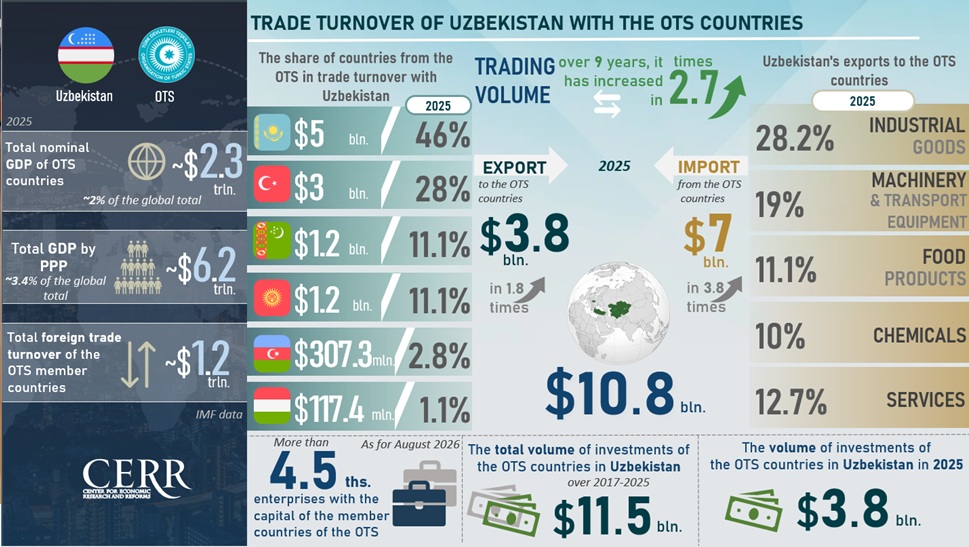
Uzbekistan has moved its economic cooperation with the Turkic states into a practical dimension
Ahead of the 13th Summit of the Organization of Turkic States, scheduled to be held in Ankara, economic cooperation within the OTS is acquiring new substance.
Water security in the turkic world: shared interests and common solutions
Water is a precious blessing that transcends national borders and has long connected peoples and civilizations.

Strengthening Transport Connectivity in Asia through the Development of the Trans-Caspian International Transport Corridor
Shifting international supply chains and expanding trade in Asia are driving demand for sustainable transport routes. For businesses, predictable delivery times, competitive rates, and reliable access to foreign markets are becoming increasingly important.