
CENTRAL ASIA ON THE THRESHOLD OF A NEW ERA
Central Asia is entering a new historically significant stage in its development. Today we are moving towards real unity. In our region, for the first time in many years, an atmosphere of trust, good neighborliness and mutual respect is being formed, which becomes the basis for joint movement forward.
This process is not spontaneous, but is the result of purposeful work and political will of the leaders of countries who have realized their common destiny and the potential for joint development. At the same time, its successful promotion is evidence of the widespread demand for regional cooperation supported by the peoples of the countries of Central Asia.
We see that conditions have been created at the state level to bring our cooperation to a new stage of regional consolidation. We face a strategic task - to translate the agreements reached into concrete results and benefits for citizens and businesses. Central Asia must become a single space of opportunities, where decisions are made not for the sake of documents, but for the sake of ensuring sustainable development and improving the daily lives of people in the countries of the region.
A striking symbol of the ongoing changes were the Consultative Meetings of the Heads of State of Central Asia, which in a relatively short historical period have become an effective mechanism for regional interaction and trusting dialogue. They emerged as the main platform for developing common approaches to strategic issues affecting the present and future of Central Asia.
The upcoming summit in Tashkent will mark a new important milestone in the Central Asian process - our joint construction of a stable, interconnected and prosperous Central Asia.
The Tashkent meeting of heads of state, as a continuation of the path we have begun, should confirm the commitment of our countries to the spirit of mutual understanding and partnership, and become a turning point in deepening regional cooperation.
The large-scale transformation of the world order, the threat of fragmentation of the global economy and the escalating problems of climate change, food and energy security have intensified our desire for consolidation.
All this requires even greater unity and coordinated actions from the countries of Central Asia. That is why strengthening our cooperation today is not just a political goal, but a strategic necessity. Central Asia has become a zone of stability and creativity, an example of how broad regional connectivity serves as a strong foundation for sustainable development and security.
A turning point in the history of regional interaction was 2017, when the format of the Consultative Meetings was initiated. For the first time in many years, the leaders of the region began a systematic and regular dialogue without external mediation, which became a symbol of new political thinking - trusting, open and based on an awareness of common interests. It was thanks to the dialogue within the framework of the Consultative Meetings that it was possible to remove a number of long-standing contradictions and move from mistrust to real cooperation.
One of the most important achievements of the new stage of regional interaction is the final settlement of border issues. What seemed impossible just recently has now become a reality. The borders that once separated us have become bridges of friendship and cooperation. The signing in March 2025 of the Treaty on the Joint of the Borders of the Three States and the Khujand Declaration between Uzbekistan, Kyrgyzstan and Tajikistan is of historical significance. This event can rightly be called epoch-making.
For the first time in the history of independence of the countries of the region, the entire perimeter of mutual borders was legally formalized, putting an end to an issue that had been a source of tension for decades.
The Fergana Peace Forum held in October became clear evidence of the mutual desire of our countries to strengthen peace and harmony in the Fergana Valley, a reflection of the creative processes occurring in Central Asia.
In the water and energy sector, which previously was the cause of acute disagreements and conflicts, fundamental positive changes are also taking place. A clear indication of fraternal cooperation is the agreement between Uzbekistan, Kazakhstan and Kyrgyzstan on the joint implementation of the Kambarata HPP-1 project, which opens a new page in the joint use of water and energy resources in the region.
An example of a reasonable compromise was the agreement between Tashkent and Bishkek on the joint use of the Chashma spring.
Cooperation on the construction of the Yavan and Fandarya hydroelectric power stations on the Zarafshan River with the participation of Uzbekistan and Tajikistan is progressing, agreements have been reached between Uzbekistan, Tajikistan and Kazakhstan on the agreed operating mode of the Bahri Tojik reservoir during the growing season.
With Turkmenistan, within the framework of an intergovernmental agreement, an agreement was reached on the rational use of water resources of the Amu Darya, which will improve joint management of water resources, while simultaneously reducing the risk of environmental problems.
All this creates a new spirit of partnership - based on trust, mutual benefit and a fair approach to shared resources. Such projects create new opportunities to support the economic activity of the population and strengthen the energy security of the region.
At the same time, serious changes are taking place in the field of border procedures and humanitarian contacts. Since September 2023, citizens of Uzbekistan and Kyrgyzstan can move freely across the border using ID cards, which has become an important step towards the formation of a zone of free movement of people. Similar agreements are being worked out with Kazakhstan and Tajikistan. Connections between regions are expanding, the volume of cross-border trade is growing, and humanitarian and cultural contacts are strengthening.
Steps to institutionalize cooperation are no less significant. Of great importance in this context was the fifth Consultative Meeting, held in Dushanbe in 2023.
It was decided to establish the Council of National Coordinators as a permanent mechanism for the preparation and implementation of agreements of the heads of state. The launch of this mechanism made it possible to make the format systematic and ensure continuity in the implementation of joint initiatives. Inter-parliamentary dialogue and regular meetings at the level of secretaries of the Security Councils have also been established.
Further strengthening of the legal framework was facilitated by the signing of the Treaty of Friendship, Good Neighborhood and Cooperation for the Development of Central Asia in the 21st Century following the Cholpon-Ata meeting of leaders in 2022, which enshrined the principles of sovereign equality, mutual support and shared responsibility for the future of the region. In 2025, Tajikistan joined this document, which was an important step towards strengthening regional unity. We welcome this decision and expect in the near future the completion of the signing of the agreement by all states of the region, which will finally consolidate the spirit of mutual trust, good neighborliness and strategic partnership in Central Asia.
In 2022, the heads of state also approved the Concept of interaction between the states of Central Asia within multilateral formats, which set the framework for coordination between the countries of the region on international platforms, including the “Central Asia Plus” formats.
An important policy document was the Concept for the Development of Regional Cooperation “Central Asia - 2040”, adopted in 2024 at the summit in Astana. It identified long-term priorities for cooperation aimed at ensuring regional security and the development of our countries.
By building an architecture of multifaceted interaction in this way, we have opened up enormous sources of growth.
Through the efforts of states, a new economic reality of the region is being formed. Over the past eight years, the total GDP of the Central Asian countries has grown almost two and a half times and reached $520 billion, and the volume of foreign trade has more than doubled - to $253 billion. At the same time, mutual trade between the countries of the region has doubled, reaching about $11 billion, and mutual investments - 5.6 times. If we talk only about our country, Uzbekistan’s trade turnover with the countries of the region has tripled - from $2.4 billion in 2016 to $7.2 billion in 2024, the number of joint ventures has exceeded 1,800.
Industry, Central Asia is experiencing steady growth of around 6 percent per year, twice the global average. This success is associated with the formation of new forms of industrial cooperation - the creation of joint investment funds (including Uzbek-Kyrgyz, Uzbek-Tajik and Kazakh-Kyrgyz), the implementation of projects in the automotive industry, electrical engineering, textile industry, and agriculture. The Action Plan for the Development of Industrial Cooperation for 2025-2027, approved by the countries of the region, is becoming an important instrument of cooperation. Border trade zones and international industrial cooperation centers are actively developing, promoting the growth of small and medium-sized businesses.
In the humanitarian sphere, strong contacts between people have been established over the years. The Dialogue of Women Leaders of Central Asian Countries and the Regional Youth Platform have been established, forums of rectors and scientists have been held since 2022, mutual years of culture, exhibitions, concerts and sporting events have become regular.
The most important thing is that our fraternal peoples feel all the positive changes taking place in their daily lives. The opening of new checkpoints and the launch of air, rail and bus routes made it possible to significantly increase the number of mutual trips and expand cultural and humanitarian ties. The share of intraregional tourism in the total tourist flows of the countries of the region exceeded 80 percent.
What until recently seemed like a dream - free movement, mutual respect, a sense of closeness and trust - is becoming a reality.
Gradually, what can be called a new regional identity of Central Asia is being born.
It is based on the recognition of existing differences and at the same time on a deep awareness of the historical kinship, cultural commonality and interdependence of the destinies of our peoples. A sense of belonging to a single regional space is being formed, where neighborhood is not a challenge, but an opportunity, where the success of one becomes a common achievement.
It is this new spirit of trust, mutual understanding and common future that today is the main support for further strengthening regional consolidation - the launch of the Central Asian process of joint construction of a sustainably interconnected, prosperous Central Asia.
And it is necessary It should be noted that each Central Asian state makes a tangible contribution to ensuring the stability and prosperity of our region, directing efforts to economic development, strengthening trust and expanding regional cooperation.
Kazakhstan is actively developing transport corridors, modernizing border points, removing trade barriers and implementing cultural and humanitarian exchange projects. Kyrgyzstan and Tajikistan consistently cooperate
on issues related to the melting of glaciers, implementing projects to modernize energy systems and develop transport connectivity. Turkmenistan is putting forward important initiatives to strengthen peace and trust, increase the transport and transit potential of the region, and adopt the UN program on the Aral Sea basin and climate technologies.
Our practical actions, responsibility for the future and commitment to the principles of good neighborliness, friendship and mutual benefit have convincingly proven: the New Central Asia is choosing the path of peace, sustainable development and creative partnership. Figuratively speaking, we are not building walls, we are building bridges.
Thanks to the progress in regional consolidation, Central Asia has now established itself as an independent and responsible participant in international relations, having a clear vision of its interests and development paths.
The “Central Asia Plus” cooperation formats have become a reflection of the increased international legal subjectivity of the region and recognition of its role as an important center of sustainability and development.
If previously the interaction of external partners was built primarily on a bilateral basis, today the leading states and associations of the world are building relations with Central Asia as an integral regional partner.
This takes the region’s cooperation with other players to a new level: when Central Asia speaks with external partners as a single subject of international relations, its voice sounds louder and more confident. Our position is becoming more significant, we can more effectively solve problems in attracting investments, strengthening cooperation with other countries in all areas.
Our openness, predictability and attitude towards dialogue have become the basis for a new perception of Central Asia in the international arena.
Currently, there are more than ten “Central Asia Plus” formats, connecting Central Asia with the leading states and associations of the world. This year alone, the summits “Central Asia - EU”, “Central Asia - China”,
"Central Asia - Russia" and "Central Asia - USA", which confirms the growing dynamics and strategic importance of the region in global politics.
More and more dialogues "Central Asia Plus" are reaching the level of heads of state, which indicates an increase in their practical significance and political weight.
Working groups are being created in a number of formats and secretariats to develop specific projects in the fields of energy, transport, green economy and digitalization.
Strengthening regional resilience is impossible without resolving issues related to Afghanistan. This country is not a periphery, but a natural part of our common region. The strength of peace and stability throughout Central Asia largely depends on the restoration and development of Afghanistan.
The long-suffering people of Afghanistan continue to live in conditions of a deep humanitarian crisis. In this regard, the countries of the region proceed from the need for the consistent involvement of Afghanistan in regional and international processes, which will contribute to the development of the country and strengthen stability in our vast region.
The construction of the Trans-Afghan Railway, which should become a link between Central and South Asia, is of key importance. The implementation of this project will create new opportunities for trade, investment and transport connectivity, and will also serve as the basis for the economic revival of Afghanistan.
At the same time, work continues to provide humanitarian and educational support to the Afghan people, develop energy cooperation and train specialists for key sectors of the economy.
Afghanistan must become part of a common space of peace and security, cooperation and development, which meets the interests of all countries in the region and contributes to the formation of a sustainable belt of stability on the southern borders of Central Asia.
As already mentioned, today Central Asia is entering a new phase of its dynamic development. We are moving from resolving bilateral issues to jointly developing responses to key regional challenges - climate change, energy transition, ensuring water and food security, and the development of digital technologies. New horizons of cooperation are opening before our countries, based on shared responsibility, mutual trust and an agreed vision of the future.
In this regard, our collective answer to a fundamental question is needed: how will Central Asia develop in the coming decades?
The population of our region is already more than 80 million people and, according to UN forecasts, by 2050 it will exceed 100 million. Central Asia is also one of the youngest regions in the world, where the average age of the population is only 29 years.
We are faced with the task of turning this demographic resource into a powerful factor of progress and innovation, creating conditions for discovering the talents and opportunities of our youth.
At the same time, it is important to emphasize the balanced approach of our countries, which is that the development of interaction should take place on a solid basis of sovereignty, equality and non-interference in internal affairs. Nobody
should not impose foreign models on the countries of the region or create supranational structures.
Cooperation in Central Asia should remain voluntary, pragmatic and focused on real results that benefit the people of our countries.
At this stage, we are faced with key tasks, the solution of which depends on the sustainability and dynamics of development region.
First, it is necessary to continue deepening regional interaction - strengthening existing mechanisms, giving them stability and practical content. Ultimately, without effective regional institutions it is impossible to ensure the systematic development of cooperation and high-quality implementation of joint decisions.
Secondly, in the field of security, our goal is to form a common capacity to counter challenges and threats. Regular meetings of secretaries of the Security Councils, heads of intelligence services, defense
and law enforcement agencies should continue. The principle of “indivisibility of security” must remain fundamental. At the same time, regional cooperation should be organically combined with existing international mechanisms, forming its own potential for strengthening stability and countering a wide range of threats to the security of countries and the region as a whole.
Thirdly, in the economic sphere it is important to develop intraregional trade, simplify border crossing procedures and create favorable conditions for mutual investment. It is necessary to more actively promote industrial cooperation, form regional and interregional supply chains, develop cross-border trade zones, expand the network of transport and economic corridors, and promote joint projects in the fields of transport, energy, agriculture and the digital economy.
We need to pay special attention to the environmental dimension of cooperation - adaptation to climate change, joint efforts to preserve transboundary water resources and biodiversity, the transition to green energy and low-carbon technologies.
Central Asia is capable and should become a region sustainable environmental development and an example of a responsible attitude towards the environment.
Fourth, humanitarian cooperation remains a priority. The central task is the development of human capital, strengthening educational, scientific and cultural ties. The creation of a common information space, improving the quality of education, healthcare and the overall development of the social sphere, including tourism and joint youth programs - all this directly contributes to strengthening mutual understanding between peoples. Of particular importance is the formation of a regional identity based on common values, cultural proximity and a joint desire for prosperity.
Fifthly, an important area is the development of coordinated approaches of the Central Asian countries in foreign policy. In the context of growing geopolitical turbulence and increased competition among world centers of power, coordination of the positions of the states of the region in the international arena is becoming a factor of sustainability and protection of common interests. On this basis, it is necessary to continue the further development of the “Central Asia Plus” formats, which have proven their effectiveness in establishing pragmatic ties with key partners.
At this stage, the strategic task is to develop regional coordination and develop agreed upon priorities and positions on cooperation with external partners in the “Central Asia Plus” formats and on other international platforms. Only in this way will we be able to fill our interaction with the leading countries and associations of the world with specific projects that contribute to economic and technological growth, the sustainability of our countries and the entire region.
For Uzbekistan, the development of regional cooperation is not a tactical choice, but a conscious strategic line arising from an understanding of our common responsibility for the future of Central Asia.
We are convinced that in an era of global uncertainty good neighborliness, cohesion and mutual support are the main resource of Central Asia. Common security and development challenges that would be difficult for countries in the region to cope with alone can be successfully addressed through joint efforts. Strengthening trust and partnership meets the interests of millions of people who connect their future with the peace, stability and development of our common native land - Central Asia.
Today we are laying a solid foundation for a New Central Asia - a strong, stable and prosperous region.
The processes taking place in our region are a conscious and irreversible choice. This path requires from us not only joint efforts, but also a willingness to take responsibility for our common future.
By combining our strengths and capabilities, we solve common problems, and also offer the international community our own time-tested and life-tested model of peaceful and creative cooperation - a model based on trust, good neighborliness and mutual support. And today, more than ever, it is important to maintain this historical momentum, strengthening what will make Central Asia a single space of peace, well-being and prosperity for all nations and peoples living in our vast region.
Shavkat MIRZIYOEV,
President of the Republic of Uzbekistan
Related news
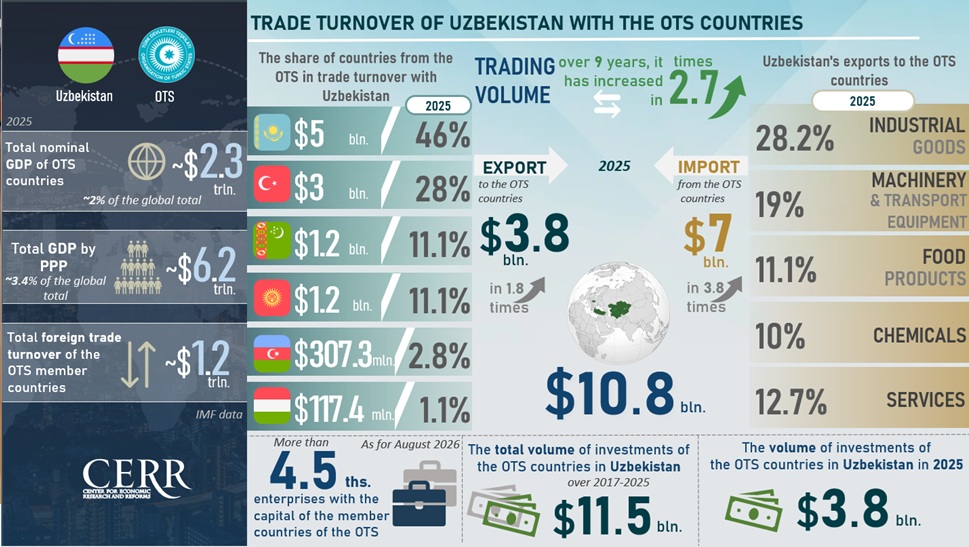
Uzbekistan has moved its economic cooperation with the Turkic states into a practical dimension
Ahead of the 13th Summit of the Organization of Turkic States, scheduled to be held in Ankara, economic cooperation within the OTS is acquiring new substance.
Water security in the turkic world: shared interests and common solutions
Water is a precious blessing that transcends national borders and has long connected peoples and civilizations.

Strengthening Transport Connectivity in Asia through the Development of the Trans-Caspian International Transport Corridor
Shifting international supply chains and expanding trade in Asia are driving demand for sustainable transport routes. For businesses, predictable delivery times, competitive rates, and reliable access to foreign markets are becoming increasingly important.