
Central Asia and the GCC: from historical ties to strategic partnership

In recent years, relations between Central Asia (CA) and the Gulf Cooperation Council (GCC) have demonstrated confident positive dynamics. Economic opportunities of the Central Asian and GCC countries, complemented by deepening political dialogue, mutual interest in cultural and historical ties and favorable geostrategic location, strengthen the strategic importance of this partnership format.
The turning point in this process was the first historical The summit of the heads of state of the GCC and Central Asian countries in Jeddah (July 19, 2023), laying the foundation for long-term strategic cooperation.
The second summit of this dialogue is scheduled for May 2025 in Samarkand. The choice of Samarkand as a venue for such an important summit is not accidental. For centuries, this illustrious city, located at the crossroads of the main roads of the Great Silk Road, was an important center for the dialogue of civilizations, diplomatic, trade and cultural exchange between East and West. In this regard, holding the event in Samarkand is intended to give new impetus to historical ties.
I. Historical ties and their transformation
Centuries-old ties between Central Asia and the Arabian Peninsula create a solid basis for the revival of mutually beneficial cooperation.
Since the 2nd century BC. The Great Silk Road ensured active trade: silk, paper, jewelry and horses were supplied from Central Asia to Arabia, and incense, spices and jewelry were brought back. This created the basis of our civilizational interconnectedness.
With the spread of Islam in the 8th century, interaction reached a new level. A special place in this process was occupied by the famous House of Wisdom (“Bayt-ul-Hikmah”) in Baghdad, where outstanding scientists of Central Asia and the Arab world together laid the foundations of global science.
Samarkand, Bukhara and Merv became not only trade, but also intellectual centers of the Islamic world. Scholars of the region made enormous contributions to theological and secular knowledge: al-Bukhari and at-Tirmidhi systematized hadith, al-Khwarizmi developed algebra, and al-Farabi and Ibn Sina combined ancient philosophy with Islamic thought.
The cities of Mecca and Medina played a special role in the development of Islamic science, which became key centers for the study of hadith, where scholars such as Ibn Abbas and Malik ibn Anas developed a methodology for collecting and verifying hadith, which became the foundation for all Islamic jurisprudence.
This network of intellectual centers, stretching from the Arabian Peninsula to Central Asia, provided an unprecedented circulation of knowledge, which led to the formation of a unified scientific space of the Islamic world.
However, from the 16th century, traditional ties began to weaken due to a series of geopolitical and geo-economic changes. The opening of sea trade routes during the Great Discovery changed global trade routes, making land routes less important. In the 20th century, the influence of international processes on the regions and the ideological barriers that arose further alienated them.
A new starting pointin the development of international relations in Central Asia was 1991, when the gaining of independence of the states of the region created the conditions for the restoration of centuries-old partnerships.
This stage is characterized by the political and diplomatic solidarity of the GCC with Central Asia and limited but important economic contacts. The Gulf countries were among the first to officially recognize the sovereignty of the new Central Asian republics.
At the same time, the opening of embassies in Central Asian capitals was not only formal in nature, but also served as aspecial political signal of the GCC's readiness to support the Central Asian countries in their peaceful formation and development.
II.Modern dynamics of interregional relations
A qualitatively new stage of interaction between Central Asia and the Gulf countries has been taking place since 2020. A significant trend of this period was the development ofinstitutional forms of cooperation. This is confirmed by the first summit of heads of state and two ministerial meetings held in 2022, 2023 and 2024.
As a result of these meetings, a Joint Action Plan for 2023-2027 was adopted, which today serves as the first conceptual document defining the long-term directions of a mutually beneficial partnership.
As a result, there has been tangible progress in the dynamics of multilateral relations in the form of a noticeable revival in trade, tourism and investment exchanges.
The total volume of investments of the GCC countries in Central Asia has shown steady growth in recent years, having increased almost 3 times since 2022. Financial interaction is also developing within the framework of Islamic finance mechanisms. The Islamic Development Bank (IsDB) invested $9.1 billion in the CIS countries, with 60% of these funds directed to Central Asia.
Central Asia is turning into an attractive destination for tourists from the GCC. For example, in 2023, more than 8.3 thousand tourists from the GCC region visitedUzbekistan, and 12 thousand in 2024 (an increase of 44.5% compared to 2023). The largest increase came from KSA (71%) and the UAE (51%).
All this became possible thanks to drastic changes in interstate relations in Central Asia. This is confirmed by the launch of the mechanism of Consultative Meetings between the heads of state of Central Asia and the rapid finding of mutually acceptable solutions to all controversial issues.
As a result of which, in a fairly short period of time, Central Asia has transformed from a potential source of conflict into a zone of stability, good neighborliness and prosperity.
This has a positive effect on the aggregate economic indicators of the region. Over the past 7 years, thetotal GDPof the Central Asian countries has grown by6.3%, intraregional trade has increased by4.4 times, and the volume of mutual investments has almost doubled.
Another important trend is the growingpolitical subjectivityof Central Asia. This is evidenced by the created dialogue formats “CA plus”, which allow us to combine the various interests of external partners, directing them in a constructive direction in the interests of sustainable development of Central Asia. Today, more than 10 similar dialogue platforms are developing quite fruitfully, of which 6 were created over the past 5 years, including Central Asia-GCC.
Summarizing the above factors, we can state that recent years have passed under the sign of the restoration of historical ties between the two regions, the construction of conceptual and institutional forms of multilateral cooperation, as well as the identification of key areas of mutually beneficial partnership.
III. Strategic goals of cooperation
Central Asia and the GCC countries have similar goals in political, economic and social development, as well as common approaches to international and regional issues.
The countries of the two regions continue to pursue mutual support within the framework of such influential international structures as the United Nations, the Organization of Islamic Cooperation, Shanghai Cooperation Organization and the Non-Aligned Movement.
Both regions are committed to diversifying their economies, reducing dependence on raw materials and creating sustainable growth models. For the Central Asian countries, this means the development of industry, agriculture and transport infrastructure, while for the Gulf states it means the promotion of innovative technologies, green economy and tourism.
Strategic programsfor the development of the countries of both regions echo the goals and objectives: Saudi Vision 2030, Oman’s Vision 2040, Bahrain’s Economic Vision 2030, We The UAE 2031, Qatar National Vision 2030, Kuwait Vision 2035, national development strategies of Kyrgyzstan until 2040, Kazakhstan until 2050, Uzbekistan, Tajikistan and Turkmenistan until 2030 open up wide opportunities for mutually beneficial partnership.
In other words, the states of the two regions are united common goals to ensure a qualitative transformation of their economies from a resource-based development model to an innovative one, which involves a high concentration of production, scientific and technical knowledge and new technologies.
Both the GCC and Central Asia are experiencing positive dynamics of economic growth. On average, the economy of Central Asia grew by 4.7% annually in 2022-2024. According to EDB estimates, in 2024 the nominal GDP of Central Asia was about $520 billion.
A similar situation is observed in the economies of the Arab Gulf states. Specifically, aggregate GDP growth in the GCC countries was estimated at 1.5% in 2023, following a record 7.9% growth in 2022. In 2024, the region's GDP growth was about 2%.
The next unifying factor is the complementarity of the economies of the two regions. The Gulf occupies a key place in the architecture of global energy security.
The GCC is also a significant international investment center, acting as a financial support for developing economies.
Central Asia contains about 20% of the world's uranium reserves, 7% of oil and natural gas, significant deposits of rare earth metals, as well as strong potential in the field hydro and solar energy. At the same time, Central Asia is rich in a growing pool of labor resources.
Both the GCC and Central Asia are strategically located. If the Gulf is located at the crossroads of major sea trade routes between Europe, Asia and Africa, then Central Asia is a strategic crossroads at the junction of important land transport corridors. In other words, from a geostrategic point of view, both regions are assigned the role of connecting global production and supply chains.
All of the above factors make the states of the two regions natural partners, creating favorable conditions for the intensification of trade and investment cooperation and the implementation of large joint projects in various industries. Realizing this, Central Asia and the GCC have already begun to establish long-term cooperation in a number of mutually beneficial areas.
IV. New horizons for partnership
The level of cooperation achieved, especially in the last 7-8 years, is impressive, but absolutely does not reflect the enormous potential that has been accumulated by the countries of the two regions. In this regard, it is proposed to focus joint efforts on the following strategic directions, which together can provide a multiplier effect.
First, intensification of trade exchanges is necessary. In 2024, the volume of trade turnover between the countries of Central Asia and the Gulf Cooperation Council amounted to about $4 billion. This is less than 1% of the GCC’s trade with the outside world, less than 2% of the trade turnover of the Central Asian states with foreign partners. This situation actualizes the need to develop and adopt amultilateral Trade Agreementinitiated by the President of the Republic of Uzbekistan during the first summit of Central Asia - Gulf Cooperation Council.
Second,building an effective model of interregional interconnectedness is impossible without the unification of the states of the two regionsreliable and extensive transport network. The insufficient development of transport and logistics infrastructure is the main barrier to the intensification of trade and economic exchanges.
In this regard, Uzbekistan advocates the development of interregional transport projects. Among them, the trans-Afghan corridor project, proposed by the President of Uzbekistan already at the first “Central Asia + GCC” summit, is of key importance. Its successful implementation, according to experts, will make it possible to diversify trade areas and reduce logistics costs.
So, Central Asia could become a “gateway” for the entry of Gulf goods and services into the vast Eurasian market. This will give a powerful impetus to the development of the emerging non-oil sector of the Arab states. At the same time, the Central Asian states will gain the shortest access to the world market through the GCC seaports.
Third, investment cooperation is mutually beneficial.. Central Asia is a large market with growing investment attractiveness. The region offers resources, transit corridors and demographic potential, which are becoming a natural target for investment funds from around the world.
Central Asian states differ from other markets in internal political stability and neutrality in foreign policy, which makes them a safe haven for long-term investments.
All of the above factors, combined with opportunities for the Gulf states, diversification of its investment portfolio makes the Central Asian region a potentially natural place for concentration of Arab investments. Such a perspective requires systematization and coordination of the current level of investment interaction. The countries of the two regions could create specific financial mechanisms of cooperation that would coordinate large projects in infrastructure, energy and high technology.
The fourth promising direction is the development of cooperation in the field of agro-industry. The countries of Central Asia could take on a key role in ensuring food security in the GCC region. This direction is of vital importance for the Arab states of the Gulf. In particular, the GCC imports 85% of its food products. It is expected that by 2028 the needs of the GCC food market will reach 59.6 million tons.
In this regard, the GCC and Central Asian countries could create joint agricultural clusters, the final product of which will be exported to the Gulf region.
Fifth. The Central Asian and GCC countries could also develop cooperation in the promotion of digital technologies through the creation of specialist exchange programs and joint projects in the field of e-government, cybersecurity and fintech.
The next step could be the joint development of telecommunications infrastructure in Central Asia, including the construction of 5G networks and data centers. This will provide additional incentives for companies and funds in the Gulf States to find their niche in the technology industry of Central Asian countries.
Another important area is strengthening scientific-intellectual interaction. Research institutes and think tanks of the two regions should play a special role in determining priority directions for the development of relations.
In this regard, in the near future it is planned to hold in Tashkent (Uzbekistan) the first forum of think tanks of the countries of Central Asia and the GCC on the general topic:“Strengthening the strategic partnership between Central Asia and the GCC: from historical ties to comprehensive cooperation,”in which they expressed their desire leading “think tanks” of our two regions will take part.
The organizers of the first interregional forum are the Institute of Strategic and Interregional Studies under the President of the Republic of Uzbekistan and the leading Saudi research Center “Gulf Research Center”.
This forum is expected to be the beginning of regular expert interaction. The platform being created could become one of many tools that promote more effective interaction between Central Asia and the Gulf countries, complementing official cooperation mechanisms.
In general, cooperation between Central Asia and the Gulf Cooperation Council opens up real strategic prospects. The unifying principle is not only cultural and historical proximity, but the complementary nature of the economies. Together, these two regions can build a mutually beneficial partnership model, where sustainable development, food and energy security, as well as digital transformation will become the basis of a new format of multilateral interaction.
Eldor Aripov,
Director of the Institute of Strategic
and interregional studies
under the President of the Republic of Uzbekistan
Abdulaziz Sager,
director of research
Gulf Research Center
Saudi Arabia
Related news
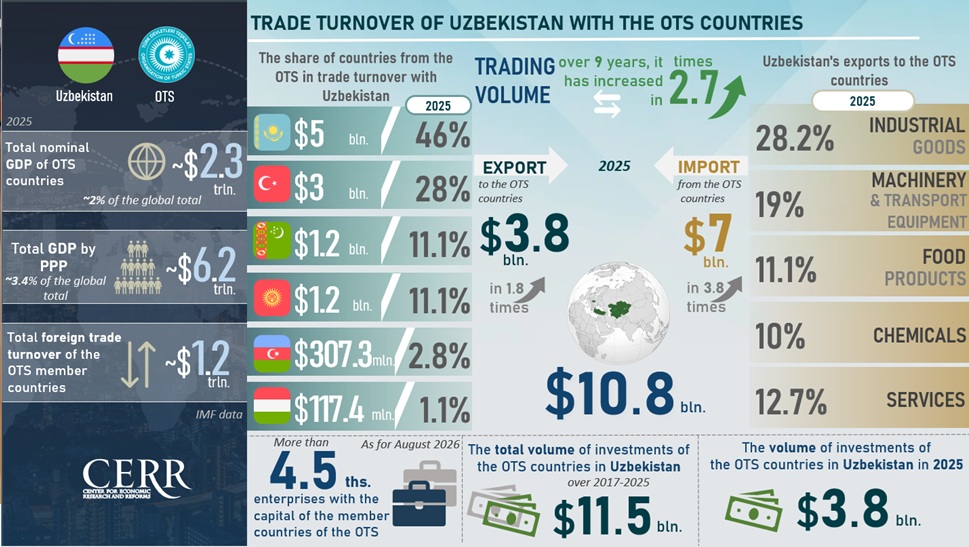
Uzbekistan has moved its economic cooperation with the Turkic states into a practical dimension
Ahead of the 13th Summit of the Organization of Turkic States, scheduled to be held in Ankara, economic cooperation within the OTS is acquiring new substance.
Water security in the turkic world: shared interests and common solutions
Water is a precious blessing that transcends national borders and has long connected peoples and civilizations.

Strengthening Transport Connectivity in Asia through the Development of the Trans-Caspian International Transport Corridor
Shifting international supply chains and expanding trade in Asia are driving demand for sustainable transport routes. For businesses, predictable delivery times, competitive rates, and reliable access to foreign markets are becoming increasingly important.