
Banking sector of Uzbekistan in the CERR rating

According to the results of the CEIR bank rating at the end of 2025, the stable positions of most financial institutions indicate an increase in the threshold of competitiveness. At the same time, a regrouping is noticeable in the middle segment.
The Center for Economic Research and Reforms presented an updated Bank Rating based on the results of the Bank Activity Index for the fourth quarter of 2025.
The study covers 35 commercial banks of the republic, of which 20 are classified as large financial institutions in terms of scale and number of branches, another 15 classified as small banks.
The methodology is based on the analysis of 27 indicators, which are compared with national averages and international standards, including the requirements of the Basel Committee.
The rating serves as an important tool for increasing transparency and strengthening confidence in the financial system. This approach is in line with international practice and is used by leading financial institutions.
Financial results for the IVth quarter of 2025
In the reporting period, the total assets of the banking sector amounted to 892.9 trillion soums($74.2 billion), liabilities - 759.8 trillion soums ($63.1 billion).
There is an increase in lending by 13%, while the growth in deposits was 31%. The share of foreign exchange transactions is decreasing, which indicates the strengthening of the national currency. Net profit reached 13.5 trillion soums ($1.1 billion), which is 57.1% higher than last year.
During the period under review, the share of problem loans decreased to 3.5% compared to 4.3% a year earlier, indicating an improvement in the quality of the portfolio. However, in some banks the indicator remains above the average level. Capital adequacy indicators exceed the minimum standards by more than 1.4 times, confirming the stability of the banking sector.
Activity rating of large banks for the IVquarter of 2025
The results of the IV quarter of 2025 showed that the leaders of the banking sector retain stable positions, while regrouping in the ranking remains limited.
The most noticeable progress was shown by Uzpromstroybank, which rose by 3 positions. Positive dynamics were also demonstrated by Davr Bank, Orient Finance Bank, Halk Bank and Ipoteka Bank, improving their positions in the overall rating.
At the same time, only two banks, from the large category, showed a decrease in activity. "Invest Finance Bank" and "Aloka Bank" each lost 4 and 3 positions in the overall rating, respectively.
In general, 13 banks maintained their positions in the overall activity rating, which, in the face of increasing competition, reflects the institution's ability to maintain operational efficiency, an adequate level of liquidity, asset quality and stability.
Dynamics of changes in key indicators
Financial intermediation. Tenge Bank and Ipak Yuli Bank showed a decrease in efficiency in attracting and allocating resources, losing 4 and 3 points respectively. National Bank, Asia Alliance Bank, Anor Bank, BRB and Microcreditbank also dropped one position in this category.
In terms of financial inclusion, a decrease of 1 point was recorded in Orient Finance Bank, Halk Bank, Agrobank, BRB and Mortgage Bank.
In terms of asset quality, six large banks showed a decrease. Agrobank lost 3 points, while National Bank, Trust Bank, Anor Bank, Aloka Bank and Asaka Bank each lost 2 points.
Despite the overall positive dynamics of profit in the sector, two banks showed a decrease in profitability - these are National Bank and Anor Bank, which dropped by 2 and 1 point, respectively.
In terms of management efficiency, weak positions were noted in Microcreditbank and Anor Bank - minus 2 points.
In terms of liquidity indicators almost a third of all large banks in the country lost their positions, where the largest decline was shown by Davr Bank - minus 6 positions, and Agrobank closed this rating, dropped to last place according to this indicator.
The activity rating of small banks for the IVquarter of 2025
The group of small banks remains relatively stable. Leaders hold their positions. The main changes in this category also occurred in the middle segment, where a number of banks improved their positions due to the growth of financial intermediation and increased profitability.
In this group, 6 out of 15 financial institutions, including the leader of the rating, Universal Bank, maintained their positions.
At the same time, five banks showed a decrease, the largest of which was shown by Ziraat Bank, which lost three lines at once, while “Apex Bank” rose by 3 lines in the overall rating.
AVO Bank and Madad Investment Bank - plus two positions each, and Octo Bank - plus one position and third place in the overall group rating.
Zhafar Khidirov,
Head Sector CEIR
Related news
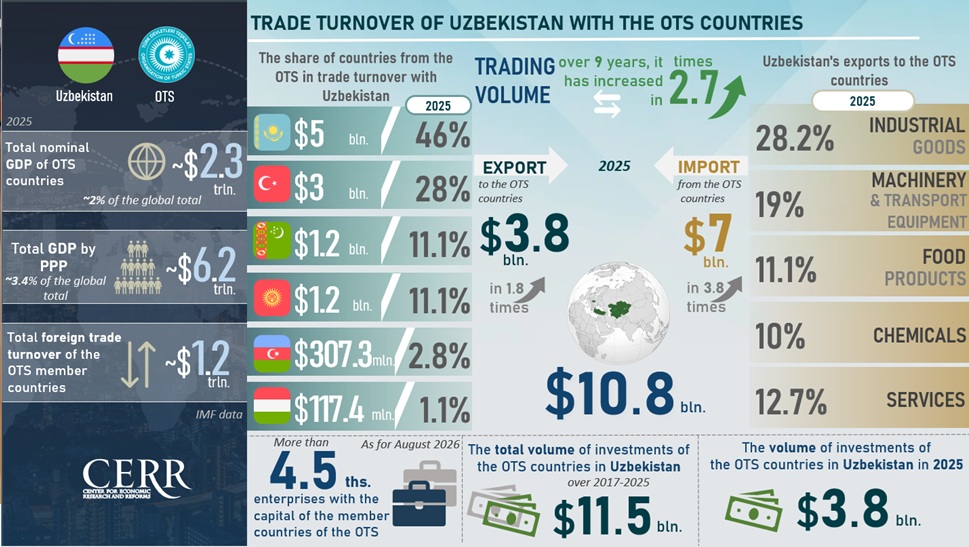
Uzbekistan has moved its economic cooperation with the Turkic states into a practical dimension
Ahead of the 13th Summit of the Organization of Turkic States, scheduled to be held in Ankara, economic cooperation within the OTS is acquiring new substance.
Water security in the turkic world: shared interests and common solutions
Water is a precious blessing that transcends national borders and has long connected peoples and civilizations.

Strengthening Transport Connectivity in Asia through the Development of the Trans-Caspian International Transport Corridor
Shifting international supply chains and expanding trade in Asia are driving demand for sustainable transport routes. For businesses, predictable delivery times, competitive rates, and reliable access to foreign markets are becoming increasingly important.