
Analysis of the implementation of economic initiatives within the framework of OTG
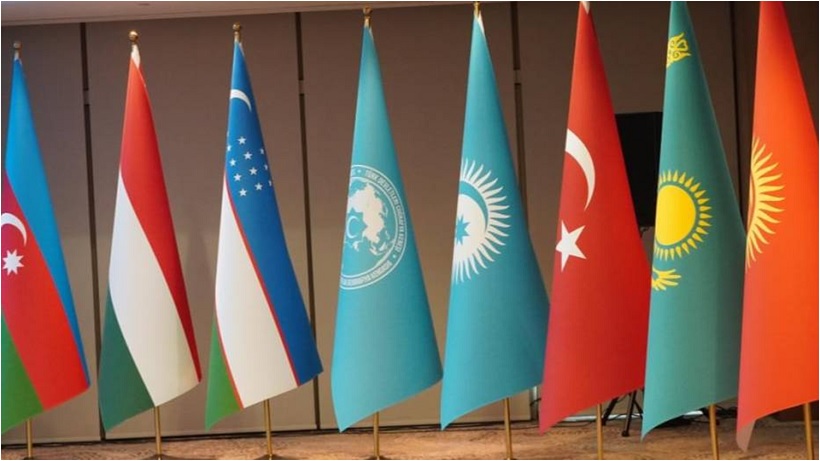
In a relatively short period of membership in the Organization of Turkic States (OTS), Uzbekistan has gone from being an observer to one of the key initiators of integration projects. The country is actively shaping the economic agenda of the organization, promoting initiatives in the areas of trade, investment, transport, digitalization and sustainable development. Today we can talk not only about declarative proposals, but also about the first results of their practical implementation, which confirms the growing role of Uzbekistan in the formation of a common economic space of the Turkic countries.
The evolution of initiatives of Uzbekistan
Since the first participation of the President of Uzbekistan in the UTC summit in 2018, our country has remained unchanged makes concrete proposals in the areas of economics, transport, digital technologies, ecology and humanitarian cooperation.
In Cholpon-Ata, the emphasis was placed on the development of trade and transport corridors. In Baku in 2019, the idea of a forum of young entrepreneurs was initiated. During the pandemic, Uzbekistan proposed creating “green corridors” and simplifying logistics. In Samarkand in 2022, they talked about creating a common space of new economic opportunities and launching the Turkic Investment Fund. In 2023–2024, initiatives were put forward to create the Turkic Development Bank, the Council of Railway Administrations and the signing of agreements on digital document management. In 2025, attention shifted to logistics; at an informal summit in Budapest, it was proposed to accelerate the implementation of single window systems and green corridors on the Trans-Caspian route.
Thus, over seven years, Uzbekistan’s initiatives have acquired a systemic character, forming a long-term strategy for economic integration, intensification of investment activity and industrial cooperation between the UTC countries.
Implementation of initiatives put forward at the summits
The past UTC summits have demonstrated that significant Some of the initiatives voiced by Uzbekistan have moved from the declarative plane to the stage of practical implementation.
First of all, it is worth noting the launch of the Turkic Investment Fund. The decision to create it was made in Samarkand in 2022, legally formalized in Ankara in 2023 and came into force at the beginning of 2024.
In February 2025, at the business forum of UTG countries in Azerbaijan, it was decided to increase the authorized capital of the Turkic Investment Fund by 20% - from $500 to $600 million, with Uzbekistan investing $100 million.
Today the fund has already begun work to support joint projects, which can be considered a major achievement in the field of financial integration. At the same time, the proposal to create a Turkic Development Bank remains under discussion and is considered as the next step in the formation of a common financial architecture.
Progress in the transport and logistics agenda is no less indicative. At the initiative of Uzbekistan, negotiations began on the creation of the Council of Railway Administrations, and documents on the implementation of electronic permits and e-TIR systems were agreed upon. These tools form the basis for the future unified digital transport space, although in practice we are still talking about pilot projects and agreed roadmaps.
The proposal to introduce “green corridors” and “single window” systems on the “Middle Transport Corridor” was also reflected in the final documents, but is at the stage of preparation for implementation. As a concrete step, the International CTC Forum on multimodal transportation and logistics is planned for November 2025 in Tashkent.
Mechanisms of cooperation in the investment sector are being developed. In June 2025, at a meeting in Tashkent, a network of investment attraction agencies TurkIPAnet was established, which unites institutions of the UTC countries.
In general, it can be stated that to date, initiatives such as the Turkic Investment Fund, digitalization of trade and transport procedures, as well as the institutionalization of dialogue in the financial sector through the creation of the Council of Central banks.
Potential of the economies of the UTG countries
The total population of the Turkic states exceeds 175 million people, GDP at purchasing power parity is $5.6 trillion, and foreign trade turnover in 2024 exceeded $1.2 trillion. However, domestic trade between countries accounts for only about 5% of this volume. At the same time, the economies of the countries are largely complementary, which opens up wide opportunities for the growth of industrial cooperation and mutual exports.
UTG countries have significant reserves of rare earth resources and a developed manufacturing industry. Using the existing potential will expand mutual trade and strengthen industrial cooperation between the UTC countries.
Uzbekistan in the UTC economy
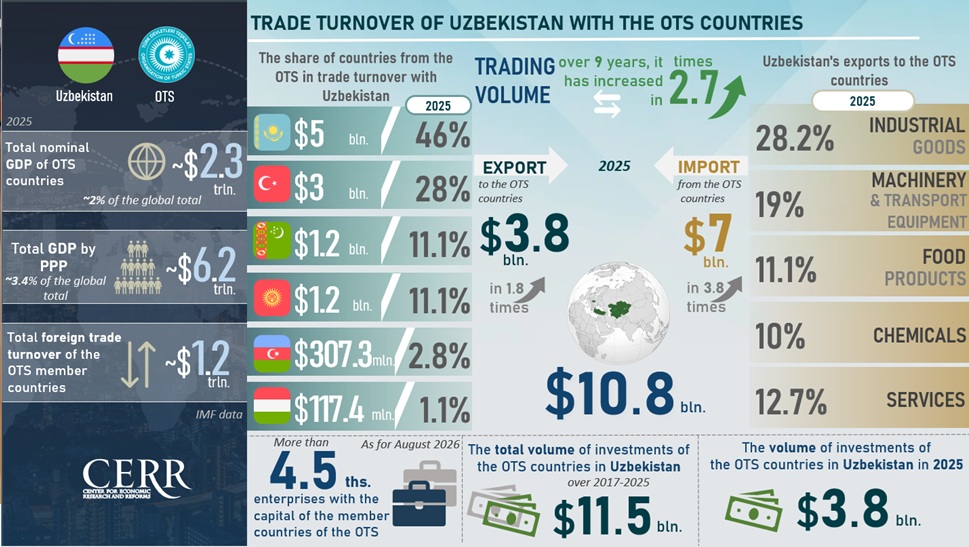
UTG countries account for 14.5% of Uzbekistan’s foreign trade. Over the past eight years, trade turnover has almost tripled - from $3.34 billion to $9.5 billion. Exports increased to $3.5 billion, imports to $6.1 billion. The main partners remain Kazakhstan ($4.3 billion), Turkey ($2.9 billion), Turkmenistan ($1.2 billion) and Kyrgyzstan ($846 million).
They occupy a significant share in the structure of exports industrial goods (33%), machinery and equipment (23%), as well as food and chemical products. According to CERR calculations, Uzbekistan is able to increase exports to UTG countries by another $2.7 billion, including to Turkey by $1.8 billion and to Kazakhstan by $500 million, to Hungary by $200 million and to Kyrgyzstan by $100 million.
Investment cooperation also shows positive dynamics, in particular from 2017 to In 2024, the volume of investments of UTG countries in Uzbekistan exceeded $7.5 billion, the number of joint ventures increased by 4.5 times. The leading investor is Turkey with $1.8 billion of investments allocated to construction, textiles and logistics.
The CEIR analysis also shows the existing additional opportunities for expanding cooperative ties with UTG countries in such industries as the textile industry, clothing and leather production, jewelry, food, construction materials, etc.
Investment cooperation between UTC countries
There is a positive trend in attracting investments from UTC countries into the economy of Uzbekistan, the total volume of which for 2017–2024 exceeded $7.5 billion, which emphasizes the countries’ strategic interest in long-term economic cooperation. Since 2017, the number of enterprises created with the participation of capital from UTG countries has increased 4.5 times to 3.6 thousand by the end of 2024.
Turkey has become the leading investor, investing $1.8 billion in the economy of Uzbekistan, which is almost 80% of the total volume of investments attracted from UTG countries. Investments are directed to the construction, textile industry and logistics development, which shows Turkey's interest in cooperation in strategically important sectors of the economy of Uzbekistan.
Conclusion
Past UTC summits have shown that the Organization already has the foundation for systemic economic integration. Uzbekistan’s proposals for the creation of the Turkic Investment Fund and the Development Bank, the launch of “green corridors” and digital trading platforms, the formation of transport councils and annual economic forums have set a vector that needs to be consistently strengthened. Further steps should be aimed at institutionally consolidating these initiatives, turning them into real operating mechanisms, and not declarations.
It is important to accelerate practical work on the harmonization of customs procedures and digital document flow so that the trans-Caspian and other transport routes become competitive at the global level.
At the same time, it is worth strengthening joint financing instruments (Turkish Investment Fund and Development Bank)so that they become the support for cooperative projects in industry, the agricultural sector and energy.
Particular attention should be paid to sustainable development, projects in the field of green economy, ecology and food security.
Thus, the experience of recent years shows that Uzbekistan became a driver of economic integration within the framework of the UTC. However, the key task of the next stage is to transform these initiatives into sustainable institutions.
Obid Khakimov,
Director of the Center for Economic
research and reforms
Related news
Uzbekistan has moved its economic cooperation with the Turkic states into a practical dimension
Ahead of the 13th Summit of the Organization of Turkic States, scheduled to be held in Ankara, economic cooperation within the OTS is acquiring new substance.
Water security in the turkic world: shared interests and common solutions
Water is a precious blessing that transcends national borders and has long connected peoples and civilizations.

Strengthening Transport Connectivity in Asia through the Development of the Trans-Caspian International Transport Corridor
Shifting international supply chains and expanding trade in Asia are driving demand for sustainable transport routes. For businesses, predictable delivery times, competitive rates, and reliable access to foreign markets are becoming increasingly important.